
In the early nineteenth century, a Dalit woman in Kerala could be legally fined for covering her breasts in public; the exposed upper body was enforced as a symbol of lower-caste submission. A low-caste person approaching an upper-caste individual had to maintain distances of up to 64 feet. Yet by 2024, this same Kerala ranks first among Indian states in the Human Development Index, leads in literacy, female empowerment, and life expectancy. The story of how this happened is one of the most extraordinary social transformations in modern history.
The Abyss: Kerala’s Caste System Before Reform
To understand how far Kerala has come, one must first reckon with how deep its caste system ran. The society that existed in Kerala, particularly in the regions of Travancore, Cochin, and Malabar, was not merely stratified. It was engineered for dehumanisation at a scale and with a legal precision that scholars have described as unique even within the broader context of Indian caste society.
Pollution, Distance, and Body as Property
The caste hierarchy in Kerala operated on the principle of tharakkastu, ritual pollution by proximity. Brahmins (Nambudiri) occupied the apex. Below them, Nairs functioned as the administrative and martial class. Then came a cascade of communities (Ezhavas, Tiyyas, Pulayas, Parayas), each required to observe escalating distances from those above them. A Pulaya was expected to keep 64 feet from a Brahmin. An Ezhava, 32 feet. A Nair had to maintain 16 feet from a Nambudiri. These were not customs; they were enforceable norms backed by the authority of the royal courts.
The violence was intimate and systemic. Nair tharavads (ancestral homes) could demand labour from lower castes with no compensation, a practice close to corvee slavery. In Travancore, there existed breast-cloth tax (mulakkaram): lower-caste women were prohibited from covering their upper bodies in the presence of upper castes, and if they chose to do so, they could be taxed. The Channar cloth agitation of the 1800s, in which women literally sacrificed their dignity fighting for the right to clothe themselves, illustrates how biology itself had been conscripted into the service of caste.
Temple roads, the physical arteries of social life, were closed to lower castes. Not just the temples, but the roads leading to them. In some districts, lower castes were forbidden from using public paths used by the upper castes at all, creating an archipelago of invisible boundaries across the geography of daily life.
| 64 Feet a Pulaya must maintain from a Brahmin | ~30% Population enslaved or near-enslaved by 1800 | ~3% Nambudiris: Brahmins who owned most of the land | 0 Schools accessible to lower castes pre-1800s |
The Nambudiri Monopoly and Nair Ambivalence
The Nambudiri Brahmins of Kerala practiced an unusual system of primogeniture: only the eldest son in a family could marry Nambudiri women and carry on the family line. Younger sons entered into sambandham, informal unions with Nair women. This gave the Nambudiris extraordinary demographic control.
The Nair community, large, internally stratified, and military, thus had a structural interest in maintaining the hierarchy. They were subordinate to Brahmins in theory but empowered over everyone below. This made them simultaneously victims and perpetrators of the caste order, a tension that would have immense consequences in the reform era.
Land ownership, crucially, was almost entirely concentrated among Nambudiris and upper Nairs under the jenmom system, a form of hereditary landlordism that bound entire communities to land they could never own. Ezhavas were predominantly toddy-tappers; Pulayas were farm labourers; Parayas were scavengers and washermen. The economy was organised around caste occupation with almost no possibility of mobility.
The Kerala that existed before the great reformers was not merely unjust. It was a machine that converted human bodies into instruments of shame, and called the arrangement sacred.
Historical Assessment, Kerala Social Reform Studies
The First Tremors: Missionary Education and Colonial Encounter (1800-1860)
The transformation of Kerala did not begin with any single dramatic event. It began, paradoxically, with the arrival of European missionaries and the destabilising force of colonial modernity, forces that, even in their exploitative dimensions, cracked open the ceiling of an otherwise hermetically sealed social order.
The Mission Schools and the Radical Act of Literacy
The London Missionary Society, the Basel Mission, and the Church Missionary Society arrived in Travancore in the early 19th century. Their primary targets were the lower castes, not because of any deep egalitarian commitment, but because the upper castes were largely unavailable for conversion. The missionaries built schools. This was not a neutral act.
When Pulaya and Ezhava children entered a classroom and learned to read, they acquired something no caste system could safely allow: the ability to read texts, engage with laws, petition authorities, and, most dangerously, compare their condition with alternatives. The mission schools in Kottayam, Nagercoil, and Thiruvananthapuram were among the first institutions in South India to educate lower-caste women.
Critically, the missionaries also documented. Their letters back to Europe described the breast-cloth tax, the distance pollution, the slavery. This documentation created pressure at the level of the Travancore Diwan and, eventually, the British Resident, making caste practices a problem of governance and international reputation, not merely local custom.
The Channar Agitation (1822-1859): The First Victory
The Channar Agitation, also called the Breast Cloth Controversy, was among the first organised lower-caste resistance movements in South Asia. Shanar (Nadar) and Ezhava women who had converted to Christianity began wearing upper-body cloths as was customary in Christian worship. The response from the Nair community was violent: attacks, public stripping, and riots.
By 1859, the Travancore government issued a formal royal proclamation permitting lower-caste women to cover their bodies, one of the first legal rollbacks of caste-based bodily discrimination in Indian history.
The Channar agitation established a template that would be used again and again: grassroots resistance by lower castes, amplified by literate advocates, leveraging colonial pressure to force concessions from a reluctant royal establishment. It was imperfect, dependent on colonial power, but it worked, and it showed that the caste wall could be moved.
1806 Vernacular Education Begins Travancore government begins funding some vernacular schools, though upper castes dominate access.
1822 Channar Women Begin Agitation Christian Shanar women begin wearing jackets; Nair landlords respond with violence and legal petitions.
1856 Slavery Abolition in Travancore The Travancore government formally abolishes agricultural slavery, decades after British India, due to sustained missionary and lower-caste pressure.
1859 Royal Proclamation on Clothing Travancore raja issues proclamation permitting lower-caste women the right to cover their upper bodies. First formal legal victory of the social reform movement.
The Philosopher Kings: Sree Narayana Guru and the Intellectual Revolution (1855-1928)
If there is one figure whose intellectual and spiritual intervention most fundamentally altered the trajectory of Kerala’s social history, it is Sree Narayana Guru, born into the Ezhava community in 1855 near Thiruvananthapuram, and dead in 1928 having transformed not just his community but the moral vocabulary of an entire civilisation.
Sree Narayana Guru | 1855-1928 · PHILOSOPHER, SAINT, REFORMER
Born Ezhava, became the most influential social reformer in Kerala’s history. Consecrated temples open to all castes, declared “One Caste, One Religion, One God for Man,” and built 65 temples that became centres of Ezhava and lower-caste dignity.
Chattampi Swamikal | 1853-1924 · PHILOSOPHER, CONTEMPORARY
Close ally and ideological companion of Narayana Guru. Challenged Brahmin monopoly on Sanskrit learning, opened Vedic and philosophical knowledge to lower castes, and critiqued the scriptural basis of caste discrimination.
Ayyankali | 1863-1941 · DALIT LEADER, ACTIVIST
Born Pulaya, organised Kerala’s Dalits with a radicalism that pre-dated Gandhi’s campaigns. Led the first agricultural strike by Dalits in 1907, organized road-access marches, and forced the right to public space onto the agenda.
Dr. Palpu | 1863-1950 · DOCTOR, POLITICAL ORGANISER
First Ezhava to become a medical doctor. Denied state service in Travancore due to caste, he petitioned the Viceroy, organised the Ezhava Memorial of 1896 with 13,000 signatures, and catalysed the formation of SNDP.
The Philosophy of “One Caste, One Religion, One God”
Narayana Guru’s intervention was philosophically sophisticated and strategically brilliant. He did not attack the Hindu tradition from outside; he attacked caste from within its own metaphysical framework. Drawing on Advaita Vedanta, he argued that if the ultimate reality is non-dual, if Brahman is present in all beings equally, then the caste hierarchy had no metaphysical basis whatsoever. His famous declaration, Oru Jathi, Oru Matham, Oru Daivam Manushyanu, meaning “One Caste, One Religion, One God for Man,” was radical precisely because it used the language of religious universalism to demolish the religion of caste distinction.
But Guru was not merely a philosopher; he was a strategist. Between 1888 and 1928, he consecrated 65 temples across Kerala and beyond. These were not upper-caste temples being opened; they were new institutions built specifically to serve lower-caste communities with dignity, on equal terms.
Whatever the religion, it is enough that man becomes good. We do not fight for a religion. We fight for human dignity.
Sree Narayana Guru
Ayyankali and the Radical Dalit Politics
While Narayana Guru reformed from within the spiritual tradition, Ayyankali, born Pulaya in 1863, operated with a more confrontational radicalism. In 1893, he rode a bullock cart through roads that were formally forbidden to untouchables, the first such act of road access defiance in Kerala.
In 1907, when a Dalit school he had organised was attacked and burned by upper-caste landlords, he organised the first agricultural labour strike in Kerala: Dalit farm workers simply stopped working. For the landlord economy of Travancore, which was utterly dependent on Pulaya and Paraya labour, this was catastrophic. Dalits won the right to educate their children.
The Ezhava Memorial of 1896: Democracy Through Petition
In 1896, Dr. Palpu, the first Ezhava to earn a medical degree, who had been denied employment in Travancore despite his qualifications solely because of his caste, submitted a petition to the Viceroy of India with 13,176 signatures. The Ezhava Memorial demanded government employment, access to public roads, temples, and schools. It catalysed the founding of the SNDP Yogam seven years later.
The Vaikkom Satyagraha and the Road to Temple Entry (1924-1936)
By the early twentieth century, the forces of reform had been accumulating for decades. What was needed was a catalysing confrontation: a battle fought in public, in the language of rights, with national attention. The Vaikkom Satyagraha of 1924-25 provided exactly that, and it connected Kerala’s local caste struggle to the national independence movement for the first time.
The Vaikkom Satyagraha (1924-25)
The roads around the Vaikkom Mahadeva Temple in central Travancore were closed to lower castes and untouchables. In March 1924, activists from the Congress movement, inspired by the SNDP and local reformers, began a satyagraha: they simply walked on the forbidden roads and allowed themselves to be arrested.
Mahatma Gandhi visited Vaikkom in March 1925, one of his earliest direct engagements with the untouchability issue. This was controversial within the movement; Periyar E.V. Ramasamy, who led the satyagraha for a period, clashed with Gandhi over strategy, with Periyar arguing that waiting for upper-caste approval was itself a capitulation to the caste hierarchy.
The Vaikkom Satyagraha ended in November 1925 without complete victory: the roads were opened to all castes except untouchables. But the political lesson was enormous. It had demonstrated that sustained non-violent public agitation could extract concessions from the royal government.
| The Gandhi-Periyar Debate at Vaikkom The tension between Gandhi’s gradualism and Periyar’s confrontational anti-caste politics exploded at Vaikkom. Gandhi believed upper-caste Hindus must themselves open temples, arguing that lower castes demanding entry without upper-caste consent was tactically self-defeating. Periyar argued that this logic perpetuated the system: it made lower-caste rights dependent on upper-caste goodwill. Both approaches would prove necessary, and both played out in Kerala over the following decades. |
The Temple Entry Proclamation of 1936
On November 12, 1936, Maharaja Chithira Thirunal Balarama Varma of Travancore issued the Temple Entry Proclamation, opening all temples under state management to all Hindus regardless of caste. The proclamation’s language was remarkable for its moral clarity: it expressed the desire that “there should be no bar against any Hindu born subject of ours on ground of caste or birth from entering our temples and worshipping therein.”
B.R. Ambedkar, who had led the Kalaram Temple entry satyagraha in Nashik and was deeply sceptical that Hindu institutions would ever reform themselves, acknowledged it as significant. For Kerala’s lower castes, it was a moment of enormous symbolic power: the sacred geography of the state was legally opened to them.
1924 Vaikkom Satyagraha Begins T.K. Madhavan and colleagues launch road-access satyagraha around Vaikkom temple. Becomes national news.
1925 Gandhi Visits Vaikkom Gandhi’s intervention nationalises the issue; partial victory achieved with roads opened to most castes.
1931 Guruvayur Satyagraha K. Kelappan leads temple entry satyagraha at Guruvayur. Gandhi fasts. Consciousness raised further.
1936 Temple Entry Proclamation Maharaja of Travancore opens all state temples to all Hindus regardless of caste, the first such proclamation in India.
CHAPTER V
The Communist Crucible: Land Reform and the State (1934-1970)
Social reform through temple entry and philosophical education was transformative. But it left untouched the economic foundation of caste: the land. As long as Nambudiri Brahmins and upper Nairs owned virtually all the arable land and lower castes were tied to it as tenants or labourers, caste subordination had a material basis that spiritual reform could not dissolve.
The Founding of the Communist Party and the Class-Caste Alliance
The Communist Party of India was founded in Kerala in 1934. E.M.S. Namboodiripad, ironically a Nambudiri Brahmin who had broken from his class to join the communist movement, became the intellectual architect of the idea that Brahminical land ownership and lower-caste labour servitude were two sides of the same system.
The Punnapra-Vayalar uprising of 1946, in which coir and agricultural workers, mostly lower caste, launched an armed revolt against the Travancore government, was brutally suppressed, with hundreds killed. But it demonstrated the depth of lower-caste anger and built enormous sympathy for the communist movement.
The 1957 Election: Democracy as Social Revolution
On April 5, 1957, the Communist Party of India won the Kerala state elections, the first time anywhere in the world that a communist party had come to power through free and fair democratic elections. E.M.S. Namboodiripad became Chief Minister.
In 1959, the Nehru government dismissed the EMS government under Article 356, one of the most controversial uses of President’s Rule in Indian history. But the political agenda of land reform and educational access could not be reversed.
The Kerala Land Reform Act of 1963 and 1969: Breaking the Feudal Spine
The land reforms that eventually passed, first in 1963 and then comprehensively amended in 1969, were among the most radical in postcolonial Asia. Tenants who had farmed land for generations received ownership rights. Ceilings were imposed on landholdings; no family could own more than a set maximum of land, with surplus redistributed.
The Nambudiri Brahmin landowning class, which had for centuries derived its social power from controlling the land, was economically broken. The abolition of tenancy gave hundreds of thousands of Ezhava, Pulaya, and other lower-caste families their first experience of owning the land they farmed.
| 1.3M Acres redistributed under land reform | 1957 World’s first elected communist government | ~40% Drop in Brahmin share of cultivated land post-reform | 1969 Comprehensive land reform: most radical in postcolonial South Asia |
Land reform in Kerala did what a hundred years of spiritual reform could not achieve alone. It broke the material basis of caste superiority. You cannot preach equality to a man who is starving on someone else’s land.
E.M.S. Namboodiripad, in retrospect
Education, Women, and the Kerala Model (1970-2000)
By the 1970s, the twin pillars of social reform, symbolic (temple entry, caste dignity) and material (land reform, labour rights), had been established. What followed was the consolidation: the construction of a mass education system, the transformation of women’s status, and the emergence of what economists and development scholars would come to call the “Kerala Model,” a form of human development that delivered health and education outcomes comparable to developed countries at a fraction of their income level.
The School as Social Equaliser
By 1991, Kerala had achieved near-universal literacy, the first Indian state to do so. More remarkably, the literacy gap between upper and lower castes was dramatically smaller in Kerala than anywhere else in India. Scheduled Caste literacy rates in Kerala in the 1990s were comparable to general population literacy rates in many other Indian states.
By 1991, female literacy in Kerala stood at over 86%, higher than many European countries had achieved at similar economic levels. This would prove to be the linchpin of the entire development story.
Female Agency and the Fertility Transition
Educated women in Kerala made different choices. They married later. They had fewer children; Kerala achieved replacement-level fertility (around 2.1 children per woman) by the early 1990s, a generation before most of India. Maternal mortality in Kerala fell to levels comparable to Sweden by the late twentieth century.
The connection is not coincidental; it is causal and well-documented in development economics. The social reform movement, by attacking both the caste subordination of lower communities and the gender subordination within all communities, created the conditions for a demographic transition that transformed Kerala’s development trajectory.
The Gulf Migration and Remittance Economy
From the 1970s onward, the mass migration of Keralites, particularly from Muslim and lower-caste communities in northern Kerala, to the Gulf states following the 1973 oil boom transformed the state. The Gulf migration was notably cross-caste: it required willingness, physical labour, and networks rather than inherited social capital.
The remittances that returned, flowing into humble homes in Malappuram, Kozhikode, Kannur, and Thrissur, created an economic levelling effect. Communities that had been landless farm labourers in the 1950s became home-owning, car-owning families by the 1990s.
Health Outcomes That Confounded Economics
By the 1980s, Kerala’s health statistics had become the subject of international scholarly attention. Life expectancy in Kerala was 70+ years, comparable to the United States, when Kerala’s per capita income was less than one-fiftieth of America’s. Infant mortality had fallen to below 20 per 1,000 live births, comparable to middle-income European countries.
In 1998, the Kerala government launched Kudumbashree, a women’s self-help group network with over 4 million members organised into neighbourhood groups running micro-credit, collective farming, small enterprises, and community services. Kudumbashree was deliberately designed to include the most marginalised: Dalit women, single mothers, women from fishing communities.
Caste in Contemporary Kerala: Progress, Persistence, and Paradox
It would be dishonest, and historically inaccurate, to suggest that caste has been abolished in Kerala. It has not. What has happened is something more specific: the mechanisms of caste oppression have been largely dismantled, while caste as a social and political identity has persisted and in some ways intensified.
What Has Been Achieved
The physical markers of caste subordination (the distance pollution, the breast-cloth tax, the prohibition from public roads and temples, the hereditary slavery) are gone. A Dalit person can enter any temple, any restaurant, any hospital. A lower-caste student can sit in the same classroom as a Brahmin child, take the same exam, and receive the same degree.
SC literacy in Kerala exceeds general population literacy in states like Bihar and Uttar Pradesh. The land reforms and reservation policies have created a substantial lower-caste middle class, a social fact that would have been literally unimaginable in 1900.
What Persists
Caste endogamy, meaning marriage within the caste group, remains overwhelmingly the norm in Kerala. The Chengara land struggle of 2007-08, in which thousands of Dalit and Adivasi families occupied a plantation estate demanding land, demonstrated that the agrarian question was not fully resolved by the 1960s reforms.
The Adivasi question remains Kerala’s most unresolved social failure. The indigenous communities of the Western Ghats, including Kurichiyar, Paniya, Oorali, and dozens of other groups, remain among the most marginalised in India.
| The Paradox of Caste Identity Without Caste Oppression One of the fascinating dimensions of contemporary Kerala is that caste identity has, in some ways, strengthened as caste-based ritual hierarchy has weakened. Communities that were once silenced now organise around their identity with pride. The caste identity that remains in Kerala today is less a hierarchy of shame and more a community of solidarity, imperfect, contested, but fundamentally different in character from the system of ritual dehumanisation that preceded it. |
The Architecture of Transformation: Why Kerala and Not Elsewhere?
The question that comparative social historians inevitably ask is: why did Kerala produce this transformation when so many other parts of India with comparable or worse caste systems did not? The answer is complex, but five structural factors stand out as decisive.
Factor 1 The Intellectual Reformers Spoke from Within Narayana Guru did not reject Hinduism; he reconstructed it from the inside, using Advaita philosophy to dismantle caste metaphysics. His message could not be dismissed as foreign or alien.
Factor 2 The Matrilineal System Created a Gender Wildcard Large portions of Kerala, including the Nair community, practised matrilineal inheritance (marumakkathayam). Women had greater property rights and social agency, creating a base for educational and political participation.
Factor 3 Multiple Competing Power Centres Prevented Monopoly Kerala had Hindus, Christians, and Muslims in significant numbers. Three royal families competed for loyalty. This competition meant no single community could entrench permanent dominance; reform movements could play one power against another.
Factor 4 The Left and Lower Castes Found Each Other In Kerala, the communist movement and the lower-caste social reform movement converged. The class and caste axes aligned: Ezhavas, Pulayas, and Muslim workers were simultaneously the working class and the lower castes.
Factor 5 The Long Gestation of Social Capital The reforms did not happen quickly. Missionary education began in the 1820s; the SNDP was founded in 1903; the Temple Entry Proclamation came in 1936; land reform in 1969. Each generation built on the previous one; the depth of the reform was proportional to its duration.
A Lesson in the Patience of Progress
Kerala’s story is not a simple triumph narrative. It is the story of a two-century-long convergence: mystical philosophers and political agitators, missionary educators and communist land reformers, Dalit women fighting for the right to cover their bodies and Brahmin dissidents fighting against their own class’s privilege, all pulling, sometimes together and sometimes in opposition, against the weight of a system that had organised itself with terrifying efficiency around human degradation.
The lesson is not that caste can be abolished by proclamation or legislation alone. The Temple Entry Proclamation of 1936 did not end caste; it ended one dimension of caste’s public power. The land reforms of 1969 did not end inequality; they ended the most extreme form of economic bondage. What accumulates, over generations, is the slow erosion of the material, psychological, and social foundations on which caste rests, until the system that once seemed eternal and sacred begins to appear for what it always was, a human arrangement, made by humans, and therefore capable of being unmade by them.
Kerala has not finished this work. Its Adivasi communities remain marginalised. Its Dalit communities face glass ceilings. But the arc of its history, from the state that taxed women’s bodies for wearing clothes to the state that leads India in human development, represents one of the most significant social revolutions in the history of the subcontinent. And it was achieved not through violence, not through the collapse of the state, but through the relentless, cumulative work of education, organisation, philosophy, and democratic politics.
References
Sree Narayana Guru and the Reform Movement
- Wikipedia: Narayana Guru — comprehensive overview of his life, philosophy, and the SNDP
- Wikipedia: Kerala Reformation Movement — broad survey of the socio-cultural shift from the 19th century onward
- Academia.edu: Sri Narayana Guru: The Light That Led Kerala — scholarly paper on Guru’s Advaita philosophy and social reform
- Academia.edu: Social Reformation in Kerala: A Quest to Modernity — examines Guru alongside Ayyankali and the Ambedkarite tradition
- Columbia University Press: Developmental Modernity in Kerala — P. Chandramohan — winner of the 2021 Kerala History Association award; rigorous academic study of the SNDP Yogam
Land Reform and Communist Politics
- Wikipedia: Land Reform in Kerala — detailed legislative history from the 1957 bill to the 1969 Act
- Foundation for Agrarian Studies: Land Reforms and Change: Illustrations from Villages in Central Kerala — links EMS’s village-level observations to macro reform outcomes
- IJCRT: Major Land Reform Legislations in Kerala (PDF) — detailed legal analysis of the 1963 and 1969 Acts
- Left Views: EMS Namboodiripad Presidential Address, International Congress of Kerala Studies — EMS in his own words on land reform and the Kerala Model
- Yale/Macmillan: Whatever Happened to Land Reform? — Robin Jeffrey (PDF) — comparative analysis of Kerala’s reforms in the national context
The Kerala Model: Education, Health, and Development
- The India Forum: The Achievements and Challenges of the Kerala Model — accessible, well-sourced overview by economist Jayan Jose Thomas
- New York Review of Books: The Kerala Difference — Amartya Sen — Sen’s own analysis of Kerala’s female literacy and health exceptionalism
- ResearchGate: Development as a Right to Freedom: An Interpretation of the Kerala Model — academic paper linking Sen’s capability approach directly to Kerala’s trajectory
Key Books
- Robin Jeffrey, Politics, Women and Well-Being: How Kerala Became a Model (Macmillan, 1992)
- Jean Drèze and Amartya Sen, Indian Development: Selected Regional Perspectives (Oxford University Press, 1997)
- Richard W. Franke and Barbara H. Chasin, Kerala: Development through Radical Reform (Promilla, 1994)
- T.C. Varghese, Agrarian Change and Economic Consequences: Land Tenures in Kerala 1850–1960 (1970)
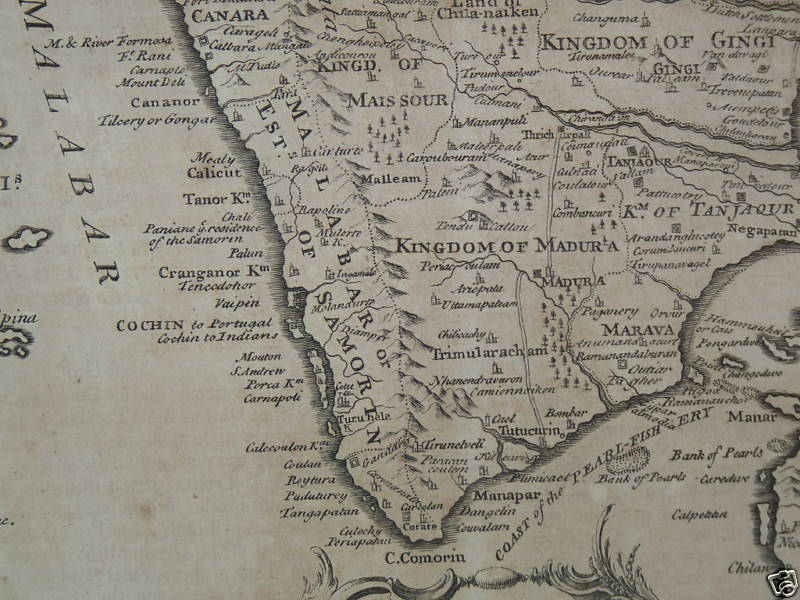
Image Courtesy: By Emanuel Bowen – eBay, Public Domain, https://commons.wikimedia.org/w/index.php?curid=12074638