
How one of the world’s oldest civilisations survived conquests, empires, colonial intrigue, and revolution to arrive at the name and nation we know today as Iran.
There is a verse in the Shahnameh, the great Persian epic composed by the poet Ferdowsi roughly a thousand years ago, that speaks of a land so ancient it carries the memory of creation itself. That land is Iran. But for most of the world, for most of recorded history, it was known by another name entirely: Persia. The story of how the country moved from one name to the other is not merely a story of paperwork or diplomacy. It is a story of survival, dignity, loss, conquest, and a fierce, unbroken sense of self that has outlasted every empire that ever tried to absorb or erase it.
India and Iran share a bond that is older than either nation in its present form. The Sanskrit word for river, “sindhu,” became the Persian “Hindu,” which gave us the very name Hindustan. The Zoroastrian Parsi community of Gujarat and Maharashtra are the direct descendants of Iranians who fled the Arab conquest of Persia in the seventh century and found sanctuary on Indian shores. Persian was the court language of the Mughal Empire. Ghalib wrote in it. Akbar dreamed in it. The connection runs deep, and it is with that spirit of kinship that this feature approaches one of history’s most remarkable stories.
Persia was not a place that happened to become a civilisation. It was a civilisation that happened to become many places.
The Ancient Foundations (Circa 3000 BCE to 550 BCE)
Long before the word “Persia” meant anything to the Greeks who coined it, the Iranian plateau was already one of the most densely inhabited and culturally active regions on earth. The Elamite civilisation, centred in what is now southwestern Iran near the modern city of Susa, was flourishing as early as 3000 BCE, with writing systems, administrative structures, and artistic traditions that rivalled anything Mesopotamia could offer.
The plateau itself is a dramatic piece of geography: a vast, elevated expanse ringed by mountain ranges on almost every side, with deserts at its heart and fertile river valleys along its edges. It was not an easy land to live in, and that difficulty shaped the people who settled it. The tribes who moved across this plateau during the second millennium BCE included the Medes in the northwest and, further south, the people who would eventually give the world its most famous ancient empire, the Persians themselves.
The Persians originally settled in a region in the southwest of the plateau called Parsa, which the Greeks would eventually render as Persis. It is from this relatively small province that the entire civilisation got the name the outside world applied to it for the next two and a half millennia. The Persians were not, for a long time, the dominant power even in their own neighbourhood. They lived under the authority of the Medes, a related Iranian people who had built the first great empire on the plateau, with their capital at Ecbatana, modern-day Hamadan. Then came Cyrus.
Cyrus the Great and the Birth of the Achaemenid Empire
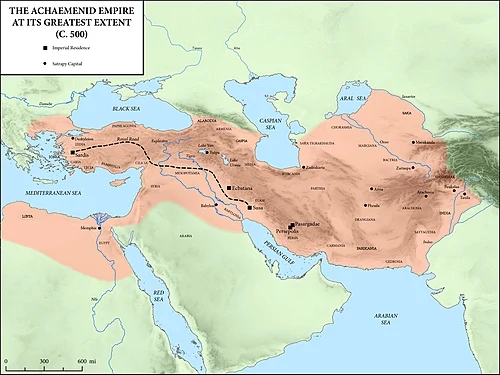
In 550 BCE, a Persian prince named Cyrus II overthrew the Median king Astyages and founded what would become the largest empire the ancient world had yet seen. The Achaemenid Empire, named after Cyrus’s ancestor Achaemenes, eventually stretched from the Aegean coast of modern Turkey in the west to the Indus Valley in the east, and from Central Asia in the north to Egypt in the south. At its height, it controlled somewhere between 40 and 45 per cent of the world’s population. No empire before it had come close to this scale.
What made the Achaemenid Empire remarkable, and what made it distinctively Persian, was not merely its size but its philosophy of governance. Cyrus is credited with issuing the Cyrus Cylinder, a clay document discovered in Babylon and now housed in the British Museum, which is widely regarded as one of the earliest declarations of human rights in recorded history. It spoke of allowing conquered peoples to return to their homelands, to worship their own gods, and to live by their own customs. Cyrus permitted the Jewish people exiled in Babylon to return to Jerusalem and rebuild their temple. He is the only non-Jewish figure in the Hebrew Bible to be called a messiah.
This was not mere generosity. It was sophisticated statecraft. The Achaemenids understood that the best way to hold together an empire of such extraordinary diversity was not to crush that diversity but to incorporate it. Satraps, or regional governors, administered the various provinces while Persian customs and the Aramaic language served as the common threads holding everything together. The result was an empire that, at its best, functioned as the world’s first successful experiment in multicultural administration.
The empire reached its territorial peak under Darius I and his son Xerxes, whose campaigns against Greece in the early fifth century BCE have been immortalised in everything from Herodotus’s Histories to the film 300. The Persian Wars, seen in the Western tradition as a heroic Greek victory, were from the Persian perspective a minor frontier conflict at the western edge of a vast empire. They did not significantly weaken Persia. But they fixed in Western consciousness an image of Persia as the great Eastern other, the embodiment of luxury, tyranny, and excess, an image that proved extraordinarily durable and extraordinarily unfair.
The Achaemenid kings governed not by erasing differences but by weaving them into a common fabric. It was empire as mosaic rather than empire as hammer.
Conquest and Continuity (330 BCE to 651 CE)
Alexander and the Wound That Never Quite Healed
In 330 BCE, Alexander of Macedon burned Persepolis, the ceremonial capital of the Achaemenid Empire, to the ground. Whether this was a deliberate act of revenge for the Persian burning of Athens 150 years earlier or a drunken mistake, as some ancient sources suggest, the effect was the same. The empire that Cyrus had built in a single lifetime was, in the span of a few years, dismantled by a twenty-something Macedonian conqueror who had not yet turned thirty.
The blow was enormous. But it was not permanent. Alexander, for all his conquests, was himself conquered by what he found in Persia. He adopted Persian dress, Persian court customs, and Persian administrative methods. He married a Bactrian princess named Roxana. He encouraged his generals to take Persian wives. He was, in short, Persianised even as he was ostensibly Hellenising Persia. When he died in 323 BCE at the age of thirty-two, he left behind no single successor capable of holding his empire together.
What followed was the Seleucid Empire, run by one of Alexander’s generals, Seleucus. Greek culture spread across the Iranian plateau, and the period is often called the Hellenistic Age. But Persian culture did not disappear. It went underground, or rather it went inward, into the villages, the temples, the oral traditions, and the Zoroastrian fire-shrines that continued to burn across the plateau regardless of who claimed to be king.
By 247 BCE, a people called the Parthians, from the northeastern corner of the Iranian plateau, began pushing back. Over the next century, they reclaimed the entire plateau from Seleucid control and established the Parthian Empire, which would endure for nearly 500 years. The Parthians were Iranian, spoke an Iranian language, and consciously positioned themselves as heirs to the Achaemenid tradition. Persian was reasserting itself.
The Sassanid Renaissance
The Parthians were followed in 224 CE by the Sassanid dynasty, and this is where the story of Persian civilisation reaches what many historians consider its second great peak. The Sassanids were intensely, almost aggressively Persian. They promoted the Zoroastrian religion as the state faith, they revived old Achaemenid traditions and symbols, they spoke of themselves explicitly as successors to Cyrus and Darius, and they built an empire that stretched from Mesopotamia to Central Asia and competed as an equal with Rome and later Byzantium.
Sassanid Persia was a world power in every sense. Its artists produced some of the most spectacular rock reliefs, silverware, textiles, and architecture of the ancient world. Its cities, including Ctesiphon near modern Baghdad, were among the largest on earth. Its scholars translated Greek philosophical and scientific texts into Pahlavi, the Sassanid Persian language, preserving knowledge that might otherwise have been lost. Zoroastrian theology, with its concept of cosmic struggle between good and evil, would go on to influence Judaism, Christianity, and Islam in ways that are still being debated by scholars today.
The Sassanid Empire lasted more than four centuries. Then, in 636 CE, Arab Muslim armies crossed into Mesopotamia and within fifteen years had overwhelmed the entire empire. The last Sassanid king, Yazdegerd III, fled eastward and was murdered in 651 CE by a local miller near the city of Merv. The Zoroastrian empire of Iran was over.
The Arab Conquest and the Persian Rebirth (651 CE to 1500 CE)
Conquest of the Body, Not the Soul
The Arab conquest of Persia is one of the most studied events in Islamic history, and it is also one of the most misunderstood. The usual framing presents it as a simple story of religious replacement: Zoroastrianism was replaced by Islam, Persian was replaced by Arabic, and a new civilisation was born. The reality was considerably more complicated.
Arabic did become the language of religion, administration, and high culture across the Islamic world, including in Iran. The vast majority of Iranians eventually converted to Islam, though this process took several generations and was not universally peaceful. Zoroastrianism did not disappear entirely. A community of Iranian Zoroastrians maintained their faith on the plateau, and a larger number fled to the western coast of India, where their descendants, the Parsis, continue to practise the religion to this day.
But here is what is remarkable: within two centuries of the Arab conquest, the Iranians had quietly taken over the Islamic world. It was Iranian administrators who built the bureaucratic systems of the Abbasid Caliphate in Baghdad. It was Iranian scholars who translated Greek knowledge into Arabic and wrote the foundational texts of Islamic philosophy, medicine, astronomy, and law. The mathematician Al-Khwarizmi, whose name gives us the word algorithm and whose work gives us algebra, was from the Khwarezm region of what is now Uzbekistan and Iran. The philosopher Ibn Sina, known in the West as Avicenna, was from Bukhara in modern Uzbekistan and wrote primarily in Persian as well as Arabic. The great Sufi poet Rumi was born in Balkh, in what is now northern Afghanistan, and wrote in Persian. The list goes on and on.
Iranian Persian did not die under Arabic influence. It was reborn. By the ninth and tenth centuries, a new form of Persian, written in the Arabic script but carrying the bones of the old Sassanid language, was flourishing as a literary language of extraordinary power. The poet Rudaki is often called the father of this New Persian tradition. Ferdowsi completed his sixty-thousand-verse Shahnameh, or Book of Kings, around 1010 CE, deliberately composing in Persian rather than Arabic as an act of cultural defiance and preservation.
The Iranians did something no other conquered people had quite managed before: they absorbed their conquerors into their own civilisation even as they formally submitted to theirs.
Mongols, Timurids, and the Persistence of Culture
Iran was invaded by the Mongols in the thirteenth century, and the destruction was on a scale that is difficult to comprehend even today. Genghis Khan’s armies wiped out entire cities, destroyed the qanat irrigation systems that had made the plateau cultivable for millennia, and killed populations that would take centuries to recover. The city of Nishapur, then one of the greatest cities in the Islamic world, was reportedly left so desolate after the Mongol sack that a Mongol princess requested it be not rebuilt but given over to the cultivation of barley.
Yet even this catastrophe was, in time, transformed. The Mongol rulers of Iran, the Ilkhanids, converted to Islam within a generation of their conquest. They became patrons of Persian art, architecture, and literature. The extraordinary paintings of the Ilkhanid period represent one of the great moments of Iranian visual culture. Tabriz under the Ilkhanids was one of the most cosmopolitan cities on earth, where Chinese, Mongol, Persian, Armenian, and European merchants and scholars mingled in ways that would not be replicated until modern globalisation.
Timur, known in the West as Tamerlane, struck Iran again in the late fourteenth century, building towers of skulls and laying waste to cities from Delhi to Damascus. But his descendants, the Timurids, presided over a Persian cultural renaissance in Herat, in what is now western Afghanistan, that is still considered one of the high points of Iranian miniature painting, architecture, and poetry. Destruction and creation followed each other across the Iranian plateau with a rhythm that seemed almost deliberate.
The Safavids and the Making of Modern Iran (1501 to 1925)
The Safavid Revolution: Shia Islam Becomes Iran’s Soul
In 1501, a young man named Ismail, the leader of a Sufi religious order from northwestern Iran, marched into Tabriz at the head of his Qizilbash followers and declared himself Shah of Iran. He also declared that Twelver Shia Islam was henceforth the official religion of his kingdom, and that his subjects would convert whether they liked it or not. The Safavid dynasty had begun, and with it, the transformation that would most profoundly shape what Iran is today.
At the time, most Iranians were Sunni Muslims. The conversion to Shia Islam was enforced vigorously and sometimes violently, with Sunni scholars being killed or expelled. But within a century, Iran had become genuinely Shia in a way that went far deeper than royal decree. The great Shia theological centres of Qom and Isfahan became the intellectual heartlands of the faith. Shia rituals, particularly the mourning of Imam Hussain at the festival of Ashura, became woven into the fabric of Iranian culture so thoroughly that they persist to this day regardless of the political system in power.
The Safavids also gave Iran something it had not had since the Sassanids: a strong, unified, recognisably Iranian state with clear borders that roughly correspond to modern Iran’s territory. Isfahan, rebuilt by Shah Abbas I in the late sixteenth and early seventeenth centuries, became one of the most beautiful cities in the world. Its great bazaar, its mosques with their turquoise domes, its bridges over the Zayandeh River, drew travellers from across Europe and Asia who went home with reports of a city that seemed almost impossibly grand. The Safavid period is when the image of Iran as the land of the turquoise dome, the walled garden, the intricate carpet, and the refined poetic culture became fixed in the world’s imagination.
Decline, Colonial Pressure, and the Question of the Name
The Safavid dynasty declined through the seventeenth and eighteenth centuries, eventually collapsing under an Afghan invasion in 1722. A succession of short-lived dynasties followed, including the brutal but effective Nader Shah, who briefly created an empire stretching from the Caucasus to northern India, and the Zand dynasty, remembered mainly for its relative gentleness.
By the nineteenth century, the Qajar dynasty was on the throne, but Iran was in a precarious position. To the north, Russia had defeated Iranian armies in two devastating wars and stripped away the Caucasian territories, including what is now Georgia, Armenia, and Azerbaijan. To the southeast, the British Empire was advancing through India and Afghanistan and was determined to keep Iran weak enough to serve as a buffer against Russian expansion. Iran became, in the language of the time, a pawn in the Great Game, the imperial competition between Britain and Russia for domination of Central and South Asia.
The Qajars signed away oil rights, telegraph rights, fishing rights, and trade concessions to foreign powers in exchange for loans and personal enrichment. The Tobacco Revolt of 1891, in which ordinary Iranians successfully pressured the Shah to cancel a British tobacco monopoly, was a remarkable early instance of popular nationalism. The Constitutional Revolution of 1906 forced the establishment of a parliament, the Majlis, and a written constitution, making Iran one of the first countries in Asia to achieve constitutionalism. These were genuine achievements against enormous odds.
It was during this period that the question of the country’s name began to surface in a new way. Iranians had always called their own country Iran, a name derived from the ancient word Aryana, meaning land of the Aryans in the old sense of the word referring to the Indo-Iranian peoples, not the later racial ideology that the term would be distorted to serve in Europe. The name Persia was entirely a Western imposition, derived from the Greek name for the province of Parsa and never used by Iranians to describe themselves or their country.
Reza Shah and the Renaming (1925 to 1935)
The Rise of Reza Khan
The Qajar dynasty ended not with a battle but with a resignation. In 1921, an Iranian officer named Reza Khan, commanding a Cossack brigade, staged a coup in Tehran and gradually consolidated power. By 1925 he had himself crowned Shah, founding the Pahlavi dynasty and taking the title Reza Shah Pahlavi.
Reza Shah was a moderniser of the most forceful kind. Inspired partly by Mustafa Kemal Ataturk’s transformation of Turkey, he set about creating a modern nation-state from what he saw as a feudal ruin. He built roads, railways, and schools. He established Tehran University. He brought women into public professional life, at least in the cities. He suppressed tribal autonomy and created a centralized national army. He replaced the turban with the Pahlavi cap and then with Western hats. He ordered women to remove the veil in public, a reform that many women welcomed and many others experienced as a violent imposition.
Alongside this domestic programme of modernisation ran a strong current of Iranian nationalist ideology, and it was within this framework that the question of the country’s name became a political matter.
March 1935: A Letter Changes the World’s Maps
In March 1935, Reza Shah’s government sent a formal request to all foreign governments asking them to use the name Iran rather than Persia in all official communications and correspondence. The request was simple and the reasoning was straightforward: Iran was the name Iranians had always used for their own country. Persia was a foreign label, and its continued use implied that the country was still the exotic, backward, orientalist fantasy of Victorian travel writing rather than a modern sovereign nation-state taking its place among equals.
The League of Nations and most countries complied without significant controversy. On the first of April, 1935, Iran officially became Iran in the eyes of the world. Persia, as an official designation, ceased to exist.
The change was not purely cosmetic. It was part of a deliberate project of national identity construction. Reza Shah’s government promoted a vision of Iranian identity rooted in the pre-Islamic past, in the glories of Cyrus and Darius and the Shahnameh, rather than in Islamic civilisation. Ancient Persian sites like Persepolis were promoted as national monuments. The Zoroastrian calendar was revived for official purposes. This was a conscious attempt to define Iran as a nation with roots far older and more glorious than the Islamic empires that had governed it for over a millennium.
It was a project with complicated consequences. The attempt to root modern Iranian identity in the pre-Islamic past would resurface repeatedly in Iranian politics, most notably in the extraordinarily lavish 2,500-year celebration of Iranian monarchy staged by Reza Shah’s son, Mohammad Reza Shah, at Persepolis in 1971, a spectacle of such breathtaking excess that it contributed significantly to the public alienation that would eventually produce the 1979 revolution.
A name is not merely a word. It is a claim about who you are, where you come from, and who has the right to define you.
The Name and the Nation Since 1935
Was the Renaming Controversial?
Among historians, the question of whether the renaming was a good idea has generated some debate. A minority of scholars argue that abandoning the name Persia was a mistake, because it severed the connection between modern Iran and the rich heritage that the word Persia evoked in the world’s imagination. Persian carpets, Persian poetry, Persian cuisine, Persian cats, the Persian Empire, these phrases carried cultural weight and affectionate associations that Iran, as a newer word to Western ears, lacked.
The majority view, however, is that the renaming was legitimate and overdue. The Iranian people had never called their country Persia. Asking them to continue accepting a foreign label on their own homeland as the price of cultural recognition was itself a form of colonialism. The argument that Persia was too culturally valuable to give up is, at its core, an argument that the convenience of Western audiences should take precedence over Iranian self-determination.
It is worth noting that the word Persian did not disappear. It continues to be used, appropriately, to describe the language, the classical culture, and the historical civilisation. One speaks of Persian poetry, the Persian language, Persianate architecture, and the Persian Gulf. Iran is the country; Persian is the adjective that describes its culture and language. The two terms coexist comfortably, as they should.
From Pahlavi Iran to the Islamic Republic
The Iran that changed its name in 1935 has itself changed enormously in the decades since. Reza Shah was forced to abdicate by the British and Soviet powers in 1941, having been seen as too sympathetic to Germany. His son, Mohammad Reza Shah, ruled until 1979, presiding over an oil boom, a controversial modernisation programme, a notorious secret police force called the SAVAK, and ultimately a revolution that swept him from power.
The Islamic Revolution of 1979 brought Ayatollah Khomeini to power and established a theocratic system unique in the modern world, combining elected institutions with a supreme religious leader whose authority superseded all others. The revolution changed Iran profoundly in its governance, its social structures, its relationship with the outside world, and its self-presentation. But it did not change the name. The country remained the Islamic Republic of Iran, not the Islamic Republic of Persia. Even a revolution built partly on opposition to the Shah’s glorification of the pre-Islamic past chose to keep the name that the Shah had formally instituted.
This is telling. Iran, as a name and as an identity, has outlasted dynasties, conquests, revolutions, and regimes. It carries within it the memory of Cyrus and Ferdowsi and Rumi and the Constitutional Revolution and the oil nationalisation of 1951 and the Green Movement of 2009 and the Woman, Life, Freedom uprising of 2022. It is a name that belongs not to any one government or ideology but to a people of extraordinary depth and continuity.
Key Dates: From Persia to Iran
| 550 BCE | Cyrus the Great founds the Achaemenid Empire; the world begins calling the region ‘Persia’ after the province of Parsa |
| 330 BCE | Alexander of Macedon conquers Persia and burns Persepolis |
| 247 BCE | Parthian Empire reasserts Iranian rule; Persian culture revives |
| 224 CE | Sassanid Empire founded; Persian language and Zoroastrian religion reach their classical peak |
| 651 CE | Arab Muslim armies defeat the Sassanids; last Persian king is killed; Iran enters the Islamic world |
| 1010 CE | Ferdowsi completes the Shahnameh, enshrining Persian language and culture against Arabic dominance |
| 1258 CE | Mongols sack Baghdad; Iran suffers devastating invasion |
| 1501 CE | Safavid dynasty founded; Shia Islam declared the state religion of Iran |
| 1906 CE | Constitutional Revolution establishes Iran’s first parliament |
| 1925 CE | Reza Khan crowned Reza Shah, founding the Pahlavi dynasty |
| 1935 CE | Iran officially requests all nations use ‘Iran’ instead of ‘Persia’ |
| 1979 CE | Islamic Revolution; the Islamic Republic of Iran is established, retaining the name Iran |
Conclusion: What a Name Carries
The story of Persia becoming Iran is, at its deepest level, a story about who gets to name the world. For centuries, Iran was Persia because that is what the Greeks called it, and Greek naming conventions, transmitted through Rome and then through European colonialism, became the default language of the world’s maps. Iranians were Persians in Western eyes regardless of what they called themselves at home.
The formal renaming of 1935 was a small act of sovereignty in some ways, simply the correction of a cartographic error. But it was also something larger. It was a declaration that the people who live on the Iranian plateau have the right to define themselves, to choose which threads of their extraordinary history they wish to emphasise, to present themselves to the world on their own terms rather than on the terms assigned to them by others.
India, which has its own long history of foreign-imposed names, should understand this instinctively. The renaming of Bombay to Mumbai, Madras to Chennai, Calcutta to Kolkata, these were similarly not merely administrative changes. They were acts of reclamation, insistences that the names a people give to their own places matter and deserve respect.
Iran today carries within it every layer of the history described in these pages. The Zoroastrian fire burns still in the Yazd desert, tended by a small community for fifteen hundred years without interruption. The poetry of Hafez and Rumi is still recited at family gatherings. The turquoise domes of Isfahan still catch the light in the way that made sixteenth-century European travellers reach for superlatives. The oil fields that made Iran a prize of the Great Game still pump beneath the desert sands.
And the people of Iran, who have survived Macedonians and Mongols and Arabs and Ottomans and Russians and the British and their own governments’ worst impulses, continue to insist on the oldest of all Iranian traditions: the stubborn, creative, poetic refusal to be eraseThey call their country Iran. It is about time the rest of the world remembered why.
Links for reference: https://www.britannica.com/place/Persis