
The Dutch entered India primarily for spice trade and focused more on the East Indies (Indonesia) than on Indian territories. Unlike the Portuguese and later the British, the Dutch showed limited interest in territorial expansion in India, preferring to concentrate their colonial efforts on the lucrative spice islands.
Dutch East India Company (VOC)
The Dutch East India Company (Vereenigde Oostindische Compagnie – VOC) was founded in 1602 through the amalgamation of several competing Dutch trading companies. It was granted a charter by the States General of Netherlands with monopoly rights over trade east of the Cape of Good Hope.
Organizational Innovation: The VOC was the world’s first multinational corporation and the first company to issue stocks and bonds to the general public. This joint-stock structure provided better financial backing than the Portuguese system and made it one of the most powerful trading companies of its era.
Key Feature: The company was controlled by 17 Directors (Heeren XVII) and had a decentralized structure with regional autonomy, making decision-making more efficient.
Dutch Establishments in India
First Factory: The Dutch established their first factory in India at Pulicat (Tamil Nadu) in 1610, though they had earlier presence at Masulipatnam (Andhra Pradesh) from 1605.
Major Dutch Settlements:
- Pulicat (Tamil Nadu, 1610) – Most important Dutch settlement in India, textile trade center
- Surat (Gujarat, 1616) – Entry point for western India trade
- Chinsura (Bengal, 1653) – Near Hooghly, important river port
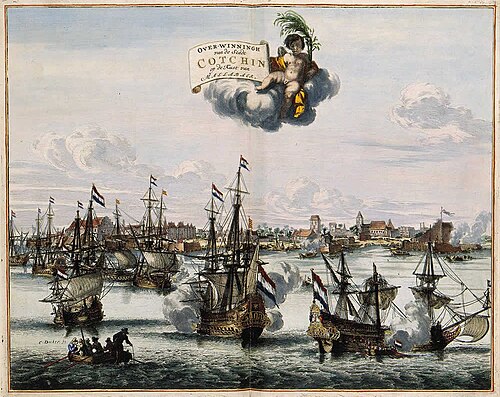
- Cochin (Kerala, 1663) – Captured from Portuguese, became major spice export center
- Nagapattinam (Tamil Nadu) – East coast trading post
- Kasimbazar (Bengal) – Silk and textile manufacturing area
- Patna (Bihar) – Saltpeter trade (essential for gunpowder)
Trade Focus: The Dutch primarily traded in spices (pepper, cinnamon, cloves), textiles, saltpeter, indigo, and silk. However, their main commercial interest remained in the East Indies rather than India.
Rise of Dutch Power
- The VOC had superior financial resources due to its joint-stock structure and public investment system.
- Dutch navigational skills and shipbuilding technology were among the best in Europe during the 17th century.
- The capture of Cochin from Portuguese in 1663 gave them control over the Malabar pepper trade.
- Dutch naval power was formidable in the early 17th century, successfully challenging Portuguese monopoly in Asian waters.
Strategic Focus: Unlike other European powers, the Dutch were more interested in establishing a commercial monopoly rather than territorial conquest. They built trading posts rather than large fortified settlements.
Military Encounters
Battle of Colachel (1741)
This was a unique instance where an Indian ruler decisively defeated a European power.
Opponents: Dutch forces vs. King Marthanda Varma of Travancore (Kerala)
Context: The Dutch tried to assert control over Travancore’s pepper trade and challenged the King’s authority.
Dutch Commander: Eustachius De Lannoy led the Dutch forces
Result: Decisive defeat of Dutch forces by Travancore army
Significance:
- Rare example of complete Indian victory over a European military force in the 18th century
- Demonstrated that European powers were not invincible when faced with well-organized Indian resistance
- Marthanda Varma’s military modernization efforts proved successful
Interesting Outcome: After defeat, the Dutch commander Eustachius De Lannoy entered Travancore service and became the Valiya Kappitaan (Senior Admiral) of Travancore. He trained the Travancore army in European military tactics and helped build modern fortifications. He remained loyal to Travancore until his death and is buried in Udayagiri Fort.
Battle of Bedara (1759)
Opponents: Dutch forces vs. English East India Company
Context: After the Battle of Plassey (1757), the Dutch attempted to challenge growing English dominance in Bengal by sending reinforcements.
Result: Dutch forces defeated by the English
Significance:
- Effectively ended Dutch political and military aspirations in Bengal
- English established unchallenged supremacy in Bengal after this victory
- Dutch confined to purely commercial activities thereafter
Why Dutch Failed in India
Strategic Choice – Focus on East Indies:
- The Dutch East Indies (present-day Indonesia), particularly the Spice Islands (Moluccas), were far more profitable than Indian trade.
- Dutch established Batavia (Jakarta) as their Asian headquarters in 1619, making it the center of their Eastern empire.
- Spices from East Indies fetched higher prices in Europe than Indian textiles.
- Limited Dutch resources were concentrated on defending and expanding their Indonesian territories.
Competition from English:
- English East India Company had better financial resources by the 18th century.
- British Royal Navy support gave English a decisive edge in naval conflicts.
- English were more aggressive in pursuing political control in India.
- Anglo-Dutch Wars in Europe (1652-1784) weakened Dutch naval power globally.
Limited Interest in Territorial Expansion:
- Dutch viewed India primarily as a source of textiles and secondary trade goods.
- They preferred maintaining trading posts rather than expensive territorial administration.
- No attempt at political interference in Indian affairs (unlike French and English).
European Wars Impact:
- Four Anglo-Dutch Wars (1652-1674, 1780-1784) in Europe severely weakened Dutch naval and economic power.
- By the late 18th century, British naval supremacy was unquestionable.
- French Revolutionary Wars (1792-1802) further damaged Dutch commerce.
Decline and End of Dutch Presence
Key Factors in Decline:
- 1759: Defeat at Battle of Bedara ended their military presence in India
- 1780-1784: Fourth Anglo-Dutch War brought catastrophic naval defeats
- 1795: VOC declared bankruptcy and was dissolved after nearly 200 years
- 1795-1815: Dutch territories came under British control during Napoleonic Wars
- 1825: Anglo-Dutch Treaty – Dutch formally ceded all Indian territories to British
Final Settlement: The Anglo-Dutch Treaty of 1824-1825 marked the formal end. The Dutch gave up their Indian possessions and focused entirely on the Indonesian colonial empire, while the British withdrew from Sumatra and recognized Dutch control over the East Indies.
Legacy: Unlike Portuguese or French, the Dutch left minimal cultural impact on India. Their presence was purely commercial and they maintained limited interaction with Indian society beyond trade.
Dutch in India Timeline
| Year | Event |
| 1602 | Dutch East India Company (VOC) founded |
| 1605 | First Dutch factory established at Masulipatnam |
| 1610 | Dutch factory established at Pulicat (most important settlement) |
| 1616 | Dutch factory at Surat |
| 1653 | Chinsura factory established in Bengal |
| 1663 | Dutch captured Cochin from Portuguese |
| 1741 | Battle of Colachel – Dutch defeated by Marthanda Varma of Travancore |
| 1759 | Battle of Bedara – Dutch defeated by English in Bengal |
| 1780-84 | Fourth Anglo-Dutch War – Dutch naval power destroyed |
| 1795 | VOC declared bankrupt and dissolved |
| 1795-1815 | Dutch territories under British control during Napoleonic Wars |
| 1824-25 | Anglo-Dutch Treaty – Dutch ceded all Indian possessions to British |
Danes in India (1620-1845)
The Danish presence in India was the smallest among all European trading companies. The Danes established a limited presence primarily focused on textile trade from South India and Bengal.
Danish East India Company
The Danish East India Company was established in 1616 under King Christian IV of Denmark. However, their actual operations in India began around 1620.
Characteristics:
- Small-scale operations compared to other European companies
- Government-sponsored company with limited capital
- Focused on textile trade, particularly cotton and silk
- Never attempted territorial expansion or political interference
Danish Settlements in India
Major Settlements:
Tranquebar (Tharangambadi, Tamil Nadu)
- Established in 1620 – First Danish settlement in India
- Obtained from Thanjavur Nayak ruler
- Built Fort Dansborg as their headquarters
- Remained Danish until 1845
- Main export: Cotton textiles
Serampore (Bengal)
- Established in 1755
- Located near Hooghly river, close to Calcutta
- Important textile and indigo trading center
- Cultural significance: Became center of missionary activity
- Famous for: Serampore Mission Press (1800) – first printing press in India to print books in Indian languages
Other Settlements:
- Balasore (Odisha)
- Calicut (brief presence)
- Oddway (near Tranquebar)
Trade Activities
Primary Trade Goods:
- Cotton textiles from Coromandel Coast
- Silk from Bengal
- Saltpeter
- Indigo
- Sugar
Limited Scale: Danish trade operations remained small-scale throughout their presence in India. They never competed seriously with larger European companies.
Cultural Contributions
Serampore Mission (1799-1845):
Despite their limited commercial success, the Danish settlement at Serampore gained cultural significance due to missionary activities.
William Carey and Serampore Trio:
- British Baptist missionary William Carey established the Serampore Mission College (1818) under Danish protection
- Along with Joshua Marshman and William Ward (Serampore Trio), he started educational and printing activities
- Translated Bible into Bengali and other Indian languages
- Started first newspaper in Bengali language
- Pioneered modern Bengali prose
Printing Press Legacy: The Serampore Mission Press printed books in multiple Indian languages, contributing significantly to vernacular literature and education.
End of Danish Presence
Why Danes Failed:
- Limited financial resources compared to English, French, or Dutch
- Small European population in India
- No naval power to protect trade routes
- No political ambitions or military strength
- Primarily focused on peaceful trade only
Sale to British (1845):
- Denmark sold all its Indian possessions to the British East India Company
- Tranquebar sold in 1845 for 12.5 lakh rupees
- Serampore sold in 1845 for approximately 1.25 lakh rupees
- Danish officials and residents were given time to leave or integrate
Peaceful Exit: Unlike Portuguese (forced out in 1961) or French (defeated militarily), the Danish exit was entirely commercial and peaceful – they simply sold their settlements when they were no longer profitable.
Danes in India Timeline
| Year | Event |
| 1616 | Danish East India Company established |
| 1620 | First Danish settlement at Tranquebar (Tharangambadi) established |
| 1620 | Fort Dansborg built at Tranquebar |
| 1755 | Serampore settlement established in Bengal |
| 1799 | Baptist Missionary Society (William Carey) arrived at Serampore |
| 1800 | Serampore Mission Press established |
| 1818 | Serampore College founded |
| 1845 | Denmark sold Tranquebar and Serampore to British East India Company |
Key Takeaway for UPSC:
- Danes had minimal political or military impact
- Cultural significance through Serampore Mission and printing press
- Peaceful exit through commercial sale in 1845
- Smallest European presence in India