
What we know, what we have just discovered, and why it still matters
Sometime around 2600 BCE, people living along the Indus River and its tributaries built cities. Not camps, not villages. Actual cities, with straight roads, brick houses, public wells, and underground sewers. They did this while most of the world was still working out agriculture. And they did it across a territory bigger than ancient Egypt and Mesopotamia put together.
That is the short version. The longer version is more complicated, more interesting, and in the past few years, significantly different from what historians believed just a decade ago. New genetic research has rewritten who the Harappans were. New climate studies have changed how we understand why their cities declined. New excavations keep pushing back how old this civilisation actually is.
This article tries to lay it all out in one place: the basics, the debates, and the newest evidence.
How it began, and how far back it actually goes
The Indus Valley Civilisation is usually dated from around 3300 BCE through to about 1300 BCE, with its peak urban period running from roughly 2600 to 1900 BCE. Those dates are still broadly correct but they keep getting revised at the older end.
In 2016, researchers studying a site called Bhirrana in Haryana found that the settlement had been continuously occupied far longer than anyone expected. Radiocarbon dating placed some of the earliest layers as far back as 7500 BCE. A more recent analysis published in early 2026 used oxygen isotopes in animal bones and optically stimulated luminescence dating of pottery to confirm occupation from at least 8,000 years ago.
To put that in perspective: when the people of Bhirrana were making pottery and keeping cattle, the Pyramids of Giza would not be built for another 4,500 years. The civilisation did not appear suddenly. It grew from Neolithic farming communities that had been in this region for thousands of years before the first cities were ever built.
Mehrgarh: where it really starts
The best place to begin the story is actually Mehrgarh, in what is now Balochistan, Pakistan. Occupied from around 7000 BCE, this Neolithic village is considered the direct cultural ancestor of the Harappan tradition. People here farmed wheat and barley, kept goats and cattle, and made increasingly sophisticated pottery over hundreds of generations. The transition from Mehrgarh’s farming villages to Harappa’s planned cities took roughly 4,500 years. That is a slow, continuous cultural evolution, not a sudden arrival from somewhere else.
The cities themselves
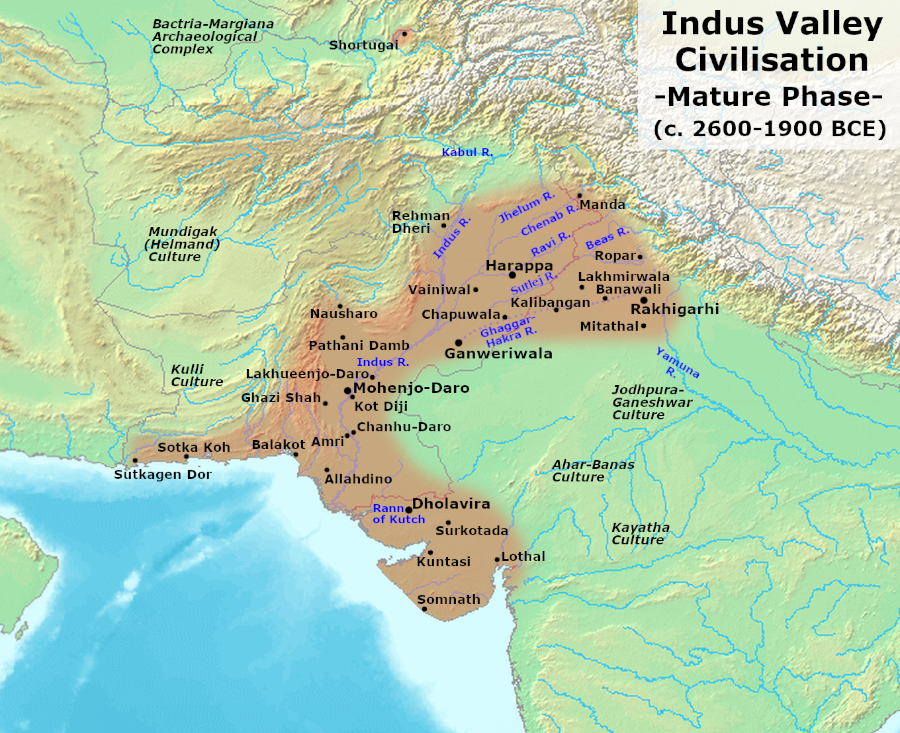
At its peak, somewhere between one and five million people lived within the Indus Valley Civilisation’s territory. That was a vast region stretching from the coasts of Gujarat in the south to the foothills of the Himalayas in the north, and from Balochistan in the west deep into what is now Haryana and Uttar Pradesh. Archaeologists have identified over 1,000 sites. About 100 have been excavated. Five were major cities. Those five were Mohenjo-daro, Harappa, Rakhigarhi, Ganeriwala, and Dholavira. Rakhigarhi in Haryana appears to have been the largest, covering over 550 hectares. Mohenjo-daro in modern Sindh, Pakistan, is the best-excavated and most well-known.
What made these cities different
The thing that strikes anyone who reads about Harappan cities is the planning. Streets ran in grids, north-south and east-west, meeting at right angles. The bricks were standardised. Across hundreds of kilometres and multiple cities, bricks were made in the same ratio: 1 to 2 to 4. That kind of uniformity does not happen by accident. Either there was a shared standard that everyone followed, or there was some central authority enforcing it. We do not know which.
Every house of any substance had a private bathroom. Waste ran through ceramic pipes into a covered brick sewer running under the street and out of the city. Mohenjo-daro had over 700 wells, roughly one for every third house. The drainage system at these cities was more sophisticated than anything in Europe until the Roman Empire, and better than what exists in parts of the developing world today.
The Great Bath at Mohenjo-daro is a large, watertight, bitumen-sealed tank about 12 metres long and 2.5 metres deep. It was almost certainly used for ritual bathing, though scholars still debate the details. What is not disputed is the engineering: the tank was built to hold water without leaking, with brick steps leading down into it from both ends and changing rooms arranged around the sides.
These were not just well-organised towns. They were cities built by people who had thought carefully about how cities should work.
What is notably absent from the Harappan cities is also telling. There are no palaces. No royal tombs piled with gold. No giant temples with armies of priests. The monumental architecture that defines ancient Egypt or Mesopotamia, built to project the power of kings and gods, simply is not there. Burials are modest and relatively uniform across social classes. Whether this means Harappan society was more egalitarian than its neighbours, or whether we just have not found the elite quarters yet, is still genuinely debated.
Trade: connected to the whole Bronze Age world
The Harappans were not isolated. They traded with Mesopotamia, with the Persian Gulf, with Afghanistan, and probably much further. Harappan seals have been found at sites in Iraq and Bahrain. Carnelian beads made in Gujarat have turned up in royal graves at the Mesopotamian city of Ur. The Sumerians had a name for the people they traded with from the east: the Meluhha. Most historians believe Meluhha was the Indus Valley.
Lothal’s dockyard, confirmed
For decades, archaeologists argued about whether a large rectangular basin at the Harappan site of Lothal in Gujarat was really a dockyard or just a water reservoir. In 2024, a team from IIT Gandhinagar settled most of that argument. Using multi-sensor satellite data and reconstructions of ancient river channels, they showed that the Sabarmati River once ran directly past the basin, and that the structure (roughly 222 metres long, 37 metres wide, and 4 metres deep) was built to connect to it. Over 140 ancient river channels were identified in the surrounding region. The evidence now strongly supports the interpretation that this was a purpose-built tidal dock, designed to let boats enter and exit as the tide rose and fell.
If that is right, Lothal has a claim to being the world’s oldest artificial harbour. It was positioned near rich deposits of carnelian, steatite, copper, and shells, all major Harappan trade goods. The beads and seals found in Mesopotamia and the Gulf almost certainly passed through here.
Weights and measures
Across the entire Harappan world, archaeologists keep finding the same small cuboid weights made from chert. They follow a binary system starting from a base unit of about 0.86 grams and doubling consistently: 1, 2, 4, 8, 16, 32. The same system, the same weights, from Balochistan to Haryana. For that to work across 1.25 million square kilometres, there had to be some shared metrological standard. Long-distance trading relationships simply require it.
The script no one can read
The Harappans had a writing system. About 4,000 inscribed objects have been found, mostly the small square seals but also clay tablets, bronze tools, and pottery. The script has somewhere between 400 and 600 distinct signs, which puts it in an awkward middle zone: too many for a simple alphabet and too few for a full logographic system like Chinese. Most researchers think it is some kind of hybrid, part phonetic and part symbol-based. It has never been deciphered.
Most inscriptions are short. The average seal has only five signs, which makes statistical analysis difficult. We know the script reads right to left, with some bidirectional exceptions. Computational linguists have run various analyses on sign frequency and sequence patterns, and some have found structural similarities to Dravidian language families. But without a bilingual text, something like the Rosetta Stone that gives the same content in a known and unknown script, nobody can crack it definitively.
The single most dramatic inscription in the Harappan record is a large wooden signboard found at Dholavira, bearing ten signs in a row. It is the only monumental public inscription ever found from this civilisation, which tells you something about how writing was used here. It was not, apparently, mainly for carving victory hymns on temple walls. It was used for administration, trade, and personal identification. The seals likely functioned like stamps or signatures. What those short texts actually say remains completely unknown.
Deciphering the Indus script would be one of the biggest archaeological breakthroughs in history. We are still waiting.
The genetics: who were these people?
This is where the story gets genuinely exciting, and where the past decade has been transformative. In 2019, an international team led by Harvard geneticist David Reich and Indian archaeologist Vasant Shinde published the first successful ancient DNA analysis from an Indus Valley individual. The subject was a woman buried at Rakhigarhi, the civilisation’s largest city, roughly 4,500 to 5,000 years ago. Of 61 skeletons screened at the site, only one yielded enough usable DNA. That alone tells you how badly South Asia’s warm, humid climate destroys genetic material over millennia.
What the genome showed was clear and significant. This woman had no ancestry from Steppe pastoralists, the horse-riding peoples from the Eurasian grasslands associated with the spread of Indo-European languages. She also had no significant ancestry from Anatolian farmers. Instead, her DNA combined ancestry from ancient Iranian hunter-gatherers with ancestry related to South Asian or Andamanese hunter-gatherers. That combination is found today in the highest concentrations among Dravidian-speaking communities in peninsular India, particularly the Irula people of Tamil Nadu and Kerala.
What this means for South Asian ancestry
When you combine the Rakhigarhi genome with genetic profiles from eleven individuals at Iranian and Central Asian sites who appear to have been Harappan migrants or traders, you can start to model the broader population. The picture that emerges is of a genetically distinct people, descended from Iranian hunter-gatherers who had separated from their western relatives at least 12,000 years ago, who developed farming independently in South Asia rather than receiving it from westward migrations out of the Fertile Crescent.
The Steppe migration that brought Indo-European languages to South Asia happened later, after the urban phase of the civilisation had already ended. The people who built Mohenjo-daro and Rakhigarhi were already gone from those cities before the horse-riders arrived.
Most importantly, Harappan genetic ancestry did not disappear. It persists in modern South Asians, forming the largest single ancestral component for people across India, Pakistan, Bangladesh, Nepal, and Sri Lanka. The Rakhigarhi woman is, in a real and literal sense, an ancestor of hundreds of millions of living people.
Why the cities were abandoned, and why the old explanations were wrong
For a long time, two theories dominated. The first, popular in the colonial era, was the Aryan invasion theory: the idea that Indo-European-speaking invaders swept in from Central Asia and destroyed the cities. The second was some kind of sudden catastrophe, a massive flood, a major earthquake, or a sudden shift in the course of the Indus River.
Neither holds up well anymore. The Aryan invasion theory is effectively dead as a primary explanation. The genetics confirm that Steppe populations arrived in significant numbers after the cities had already been abandoned. There is no evidence of conquest-level violence at the major Harappan sites. And the transition from Mature to Late Harappan culture was gradual, not sudden.
What the climate data actually shows
The current best explanation involves a long, grinding climate crisis, specifically a series of severe droughts. A study published in late 2025 in Communications Earth and Environment combined climate modelling with chemical data from cave stalagmites and lake sediments across the Indus region. The results showed a sustained drying trend beginning around 5,000 years ago, with several major drought periods each lasting more than 85 years, occurring between roughly 4,400 and 3,400 years ago. The worst of these droughts, centred around 3,757 years ago, may have lasted 150 years and reduced rainfall across nearly the entire Indus basin by around 13 percent. When the researchers ran those rainfall reductions through a river flow model, they found that water levels near the major cities dropped by more than 12 percent. That kind of sustained reduction would have put enormous pressure on farming and urban water supplies. Crucially, the decline was not sudden or uniform. Different cities were abandoned at different times. The people did not die; they moved. Population drifted east toward the Gangetic plains where monsoon rains were more reliable. Cities shrank and were eventually vacated. The civilisation did not collapse so much as it dispersed.
Adaptation, not collapse: the Bhirrana evidence
The 2026 study at Bhirrana added an important nuance. By reconstructing both the climate record and the cultural sequence at a single site over 5,000 years, researchers could directly compare environmental change with human response. As the monsoon weakened, the Harappans shifted their crops. They moved away from water-hungry wheat and barley toward drought-resistant millets and rice.
That is not collapse. That is adaptation. The big cities shrank because the economic model that sustained them stopped working in the new climate. But the people kept going, farming differently and living more dispersedly. The story of the Harappan decline is less a story of catastrophe and more a story of civilisational reinvention.
Major sites worth knowing
Mohenjo-daro
Located in modern Sindh, Pakistan. The most excavated Harappan city and the one most people picture when they think of this civilisation. Grid streets, the Great Bath, over 700 wells, a dedicated craft district. UNESCO World Heritage Site since 1980 but currently threatened by rising groundwater and salt damage. The name means ‘Mound of the Dead’ in Sindhi. Archaeologists gave it that name when they found it. We have no idea what the people who lived there actually called it.
Harappa
Located in modern Punjab, Pakistan, near the Ravi River. The first site excavated, in 1920 and 1921, and the one that gave the civilisation its alternate name. The site was badly damaged in the nineteenth century when local workers quarried its bricks for railway construction. Despite this, ongoing excavations have produced the most complete cultural sequence of any Harappan site, showing five distinct phases from before 3500 BCE to around 1900 BCE.
Rakhigarhi
Located in Haryana, India. The largest known Harappan city, covering over 550 hectares. This is also where the Rakhigarhi woman was found, whose DNA changed our understanding of South Asian prehistory. Excavations have been ongoing since the late 1960s. A large portion of this site has never been dug.
Dholavira
Located on the island of Khadir in Gujarat’s Rann of Kutch. One of the most complete Harappan cities in India, added to the UNESCO World Heritage List in 2021. Built in an arid region, its water management system is the most sophisticated of any Harappan site, with a network of reservoirs, dams, and channels that let the city survive in a landscape that receives very little rain. The wooden signboard bearing the only monumental Indus script inscription was found here.
Lothal
Located in Gujarat. Smaller than the main cities but historically significant as the civilisation’s primary maritime trading hub. The 2024 IIT Gandhinagar study gave serious scientific backing to the idea that the large basin here was a purpose-built tidal dock, likely the oldest known artificial harbour in the world. Harappan carnelian beads and seals found in Mesopotamia and the Persian Gulf were almost certainly shipped through here.
Recent discoveries worth knowing about
A new site in the Thar Desert (2024)
In 2024, a history lecturer named Dilip Kumar Saini and a local researcher named Parth Jagani found a Harappan site at Ratadiya Ri Dheri in Jaisalmer district, Rajasthan. It is the first known Indus Valley settlement in the Thar Desert. The site dates to the Mature Harappan phase and sits just 17 kilometres from the Pakistan border. Artefacts include red ware pottery, terracotta cakes, stone tools, and chert blades typical of the Sindh Harappan tradition. It is a rural settlement, not a city, but its location in the deep desert shows how far the Harappan network actually reached.
Harappa as a migrant city
Chemical isotope analysis of teeth from a Harappan cemetery at Harappa showed that many of the people buried there had grown up somewhere else, outside the city. This is the first hard physical evidence that Harappa drew migrants from across the Harappan world. The city was not just a large local community. It was genuinely cosmopolitan, pulling in people from distant regions the way major cities always have.
The 2025 drought study
Published in Communications Earth and Environment, this is the most detailed climate reconstruction of the Harappan period to date. By combining cave stalagmite isotope data, lake sediment records, and river flow modelling, researchers identified four significant drought periods between 4,445 and 3,418 years ago, each lasting over 85 years. The most severe reduced basin-wide rainfall by about 13 percent and coincides with the period of maximum urban abandonment in the archaeological record. The civilisation’s decline was real, prolonged, and driven substantially by water stress, but it was a long fade, not a crash.
What they left behind, and what still puzzles us
The Harappans left no deciphered texts, no named kings, no creation myths we can read. What they left were objects: seals, beads, weights, pots, figurines, drains. From those objects, archaeologists have built up a reasonable picture of how these people organised their lives. The inner life of the civilisation, the religion, the politics, the literature if any existed, remains out of reach. A few things are worth noting about the objects they did leave. The bronze Dancing Girl from Mohenjo-daro is a small female figurine, arm on hip, head slightly tilted, technically confident and strikingly modern-looking. The Priest-King head, carved in steatite with a trefoil-patterned robe, suggests some kind of ceremonial or administrative elite. The seals carry images of animals (bulls, tigers, rhinos, elephants) carved with a precision and naturalism that matches anything produced elsewhere in the Bronze Age world. One seal found at multiple sites shows a horned figure seated in what looks like a yoga posture, surrounded by animals. Some scholars interpret this as an early form of Shiva, specifically the deity Pashupati or ‘lord of animals’. Others are more cautious. But the possibility that certain Harappan religious ideas fed into later Hinduism, filtered through millennia of cultural change, is at least plausible.
The Harappans left no named kings, no epic poems, no victory columns. What they left were drains, weights, and seals: the infrastructure of a working civilisation.
Does it matter today?
Yes, and more directly than most people realise. The Rakhigarhi genome study showed that Harappan ancestry forms the largest single genetic contribution to modern South Asians. That holds across the Indian subcontinent: India, Pakistan, Bangladesh, Nepal, Sri Lanka. When South Asians today look for a deep biological ancestry, the Harappans are it, to a greater degree than any other single group. Beyond genetics, the cultural continuities are debated but real. The pipal tree, sacred in Hinduism, Buddhism, and Jainism, appears on Harappan seals. So does the swastika as a symbol of auspiciousness, millennia before it was misused in Europe. The practice of ritual bathing, so central to Hindu religious life, might trace back to the Great Bath at Mohenjo-daro. The humped bull, the naga serpent motif, the goddess figurines found in abundance at Harappan sites all have echoes in later South Asian religious traditions. None of these connections are certain. Cultural diffusion over 3,000 years is hard to prove. But the genetic continuity at least means the people were connected. The ideas had a vehicle to travel through time.
What we still do not know
Quite a lot, frankly. The undeciphered script is the most obvious gap. It keeps the entire religious, political, and literary life of the civilisation sealed off from us. But there are others. We do not know how the cities were governed. No palaces, no obvious royal symbols, no texts to tell us. Some kind of civic administration clearly existed. You cannot standardise bricks across 1.25 million square kilometres without organisation. But what form it took is unknown. Were these city-states? A confederation? A trade federation? Nobody knows. We have very little ancient DNA from the Harappan period. The single Rakhigarhi genome was transformative, but one person from one city is a thin basis for characterising a civilisation that covered a huge area and lasted thousands of years. Teams are working on extracting more DNA from other sites, but South Asia’s climate makes this very difficult. We do not know the full extent of the civilisation. The map keeps growing. The Thar Desert site found in 2024 extended the known range further into the desert. Satellite surveys keep identifying new mounds and buried settlements. The total number of sites, and the total population the civilisation supported, are almost certainly larger than current estimates.
A final thought
There is something both humbling and exciting about the Indus Valley Civilisation’s place in history. It was almost certainly the largest urban civilisation of the Bronze Age, covering more territory than Egypt or Mesopotamia, housing more people than either. Its cities had better sanitation than most of the ancient world. Its people traded across thousands of kilometres, maintained consistent standards across a continent, and built, quietly and without pyramids or conquest hymns, one of the most organised societies the ancient world produced. And then for about 3,500 years, almost all of it was buried and forgotten. We have only been excavating it seriously for about a century. Ancient DNA from this civilisation only became available in 2019. The 2025 climate study came out just a few months ago. In the scheme of things, we are still near the beginning of understanding what this civilisation was and what it means.
Every few years, a new study changes something significant. Bhirrana pushed the origins back thousands of years. Rakhigarhi’s genome reset the entire ancestry discussion. Lothal’s dockyard went from disputed hypothesis to well-supported reality. The drought records from cave stalagmites gave us, for the first time, something close to a detailed account of what the climate was doing when the cities emptied out. The Indus Valley Civilisation is not a closed chapter. It is a live investigation. And given that its genetic descendants number in the billions, and that it laid cultural foundations that still shape life across the subcontinent today, it is one of the most personally relevant investigations in all of archaeology.
Sources and Further Reading
Shinde, V., Narasimhan, V.M., et al. (2019). An Ancient Harappan Genome Lacks Ancestry from Steppe Pastoralists or Iranian Farmers. Cell, 179(3).
Narasimhan, V.M., et al. (2019). The formation of human populations in South and Central Asia. Science, 365(6457).
Solanki, H., Jain, V., Thirumalai, K., Mishra, V., et al. (2025). River drought forcing of the Harappan metamorphosis. Communications Earth and Environment, 6, 926.
Gupta, E., Prabhakar, V.N., Jain, V. (2024). Sabarmati and its connection with the Harappan port Lothal. Journal of Archaeological Science, 170.
Bhirrana stratigraphic and isotope study (2026). Scientific Reports.
Saini, D.K., Jagani, P. (2024). Discovery of Harappan site at Ratadiya Ri Dheri, Jaisalmer.
Kenoyer, J.M. (1998). Ancient Cities of the Indus Valley Civilization. Oxford University Press.
Possehl, G.L. (2002). The Indus Civilization: A Contemporary Perspective. AltaMira Press.
Image Courtesy: By Avantiputra7 – Own work, CC BY-SA 3.0, https://commons.wikimedia.org/w/index.php?curid=33202416