
The Portuguese were the first Europeans to arrive in India at the end of the 15th century, establishing control over key maritime trade routes. Their arrival reshaped global trade patterns and opened the door for other European colonial powers to enter the Indian subcontinent.
Portuguese in India
Vasco da Gama reached Calicut on 20 May 1498, where he was welcomed by the Zamorin, the ruler of Calicut. He was guided by Arab navigator Ahmad Ibn Majid to reach India via the Cape of Good Hope. On his return, the cargo he carried fetched profits almost sixty times the cost of his expedition. This marked the beginning of direct trade between India and Portugal.
Interesting Fact: When Vasco da Gama first met the Zamorin, he brought gifts including cloth, hats, sugar, oil and honey. The Zamorin was reportedly disappointed with these ordinary items, as Arab traders had been bringing much more valuable gifts for centuries. This cultural misunderstanding created initial tensions in Portuguese-Indian relations.
Francisco de Almeida arrived in 1505 as the first Portuguese viceroy in India. He is remembered for the ‘Blue Water Policy’, which emphasized Portuguese naval supremacy in the Arabian Sea and the Indian Ocean. Almeida famously said, “Let it be known that the King of Portugal is the lord of the navigation, trade and commerce of Ethiopia, Arabia, Persia and India.”
Unique Strategy: Almeida’s Blue Water Policy was strategically innovative – instead of capturing extensive land territories (which were expensive to maintain and defend), he focused on controlling sea routes through a network of fortified naval bases at strategic points. This approach made the Portuguese maritime empire more cost-effective and sustainable compared to traditional land-based empires that required large standing armies and administrative apparatus.
Alfonso de Albuquerque captured Goa from the Sultan of Bijapur in 1510, making it the political and military base of the Portuguese. He is known as the “Real Founder of Portuguese Power in India”. Over time, they also established trading centers at Cochin, Daman, and Diu.
Fascinating Policy: Albuquerque actively encouraged Portuguese soldiers to marry local Indian women through his “Estado da India” policy. He offered incentives including land grants and government positions to create a stable Portuguese-Indian community (called Luso-Indians or Goans). This was unique among European colonizers and created a distinct Indo-Portuguese culture that survives in Goa today.
Little Known Fact: Albuquerque captured Goa on St. Catherine’s Day (25 November 1510). The Portuguese considered this divine intervention, and St. Catherine became the patron saint of Goa. Even today, the Se Cathedral in Old Goa houses the Chapel of St. Catherine.
The Portuguese extended their influence across the Asian coastline, stretching from Hormoz in the Persian Gulf to Malacca in Southeast Asia. For almost a century, they maintained a near monopoly over the higher Eastern trade.
Rise of Portuguese in India
- As the first Europeans to arrive in India, the Portuguese quickly established dominance on the Malabar Coast. Within fifteen years, they dismantled Arab supremacy in Indian Ocean trade, securing Goa, Daman, Diu, and Cochin.
- Spanish king Charles V gave up ambitions in the Indian Ocean, leaving Portugal a free hand to build its Eastern maritime empire.
- During their formative years, the Mughals posed no threat to Portuguese expansion. Even later, Mughal rulers showed little interest in naval development since their core territories were landlocked and less engaged with southern maritime affairs.
- The Portuguese navy enjoyed a decisive edge due to advanced navigational skills, superior shipbuilding, and the use of gunpowder weaponry.
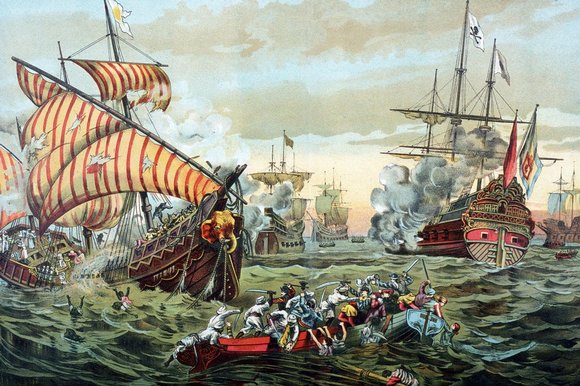
- Battle of Diu (1509): Francisco de Almeida defeated the combined fleet of Gujarat Sultan, Egypt, and Zamorin. This established Portuguese naval dominance in the Indian Ocean and secured their monopoly over Indian Ocean trade routes.
- Albuquerque’s conquest of Goa in 1510 gave the Portuguese a stronghold on India’s west coast, enabling them to dominate Malabar trade and keep watch over Deccan politics.
- The introduction of the Cartaz (pass system) forced Asian and Arab traders to seek Portuguese permission to sail. This consolidated their control over sea-borne commerce. All ships required Portuguese permits to trade, and violators faced seizure of goods and ships.
Revolutionary System: The Cartaz system was an innovative naval licensing mechanism. Ships had to pay fees and carry Portuguese passes with specific details of cargo, destination, and route. This was enforced by Portuguese patrol ships throughout the Indian Ocean. Arab and Asian merchants who had freely traded for centuries now had to pay tribute to Portuguese authorities.
Economic Impact: The Cartaz system generated enormous revenue for Portugal without extensive territorial conquest – demonstrating an early form of maritime taxation and control. However, it also created deep resentment among Indian and Arab merchants, who saw it as extortion.
Important Portuguese Governors
Francisco de Almeida (1505-1509)
- First Portuguese Governor in India
- Introduced the Blue Water Policy focusing on naval supremacy
- Won Battle of Diu (1509) defeating combined fleet of Gujarat Sultan, Egypt and Zamorin
- Established Portuguese control over Indian Ocean trade routes
Alfonso de Albuquerque (1509-1515)
- Known as “Real Founder of Portuguese Power in India”
- Captured Goa from Bijapur Sultan (1510) and made it capital
- Captured Malacca (1511) for control of spice trade from East Indies
- Captured Ormuz (1515) in Persian Gulf
- Introduced Cartaz System – trade permit/license system
- Encouraged Portuguese-Indian marriages creating mixed communities
Nino da Cunha (1529-1538)
- Shifted capital from Cochin to Goa (1530) for better strategic position
- Acquired Diu (1535) through treaty with Gujarat Sultan
- Acquired Bassein (1534) and Daman (1559)
First Factory of Portuguese in India
The First Factory of Portuguese in India was established at Cochin in 1503, making it the first permanent Portuguese settlement in India. This factory became a major center for the spice trade, particularly pepper and ginger, which were in great demand in Europe.
An earlier trading post was set up at Calicut (Kozhikode) in 1500 under Pedro Álvares Cabral, but Cochin became the more important and lasting establishment due to better relations with local rulers.
Portuguese Settlements in India
Major Territorial Holdings:
- Goa – Capital, religious and administrative center (captured 1510)
- Daman – North of Mumbai, strategic port (captured 1559)
- Diu – Island near Gujarat coast, naval base (acquired 1535)
- Bassein (Vasai) – Near Mumbai (captured 1534)
- Cochin – Kerala, first factory (1503)
- Hooghly – Bengal, river port
- San Thome (Mylapore) – Near Madras
Cultural Legacy: The Portuguese played a significant role in introducing several new crops to India including cashew, pineapple, guava, papaya, and chilli. Today’s Indian cuisine heavily relies on chilli, which was brought to India from the Americas by the Portuguese. They also introduced tobacco cultivation and promoted cultivation of certain fruit trees.
Linguistic Impact: Many Indian languages absorbed Portuguese-derived words that are still used in daily conversation:
- Marathi/Hindi: “चाबी” (chavi/key from “chave”), “मेज़” (mez/table from “mesa”), “अलमारी” (almari/cupboard from “armário”)
- Konkani: Continued to be written in Roman script due to Portuguese influence
- English vocabulary: Words like “Caste” (from Portuguese “casta”) and “Mango” (from Portuguese “manga”) entered English through Portuguese trade connections
Architectural Heritage: Portuguese introduced distinctive architecture combining European and Indian elements. The Bom Jesus Basilica in Old Goa (built 1594-1605), a UNESCO World Heritage Site, houses the mortal remains of St. Francis Xavier and showcases Baroque architecture – among the earliest examples of this style in India.
Decline of Portuguese in India
Internal Factors:
- Religious Intolerance: Goa Inquisition (1560) led to harsh persecution and forced conversions that alienated the local population. Portuguese destroyed temples and Hindu cultural institutions.
Dark Chapter: The Goa Inquisition (1560-1812) was one of the most brutal religious tribunals established by colonial powers. Introduced following St. Francis Xavier’s advocacy, it targeted Hindus, Muslims, and even ‘New Christians’ (converted Catholics suspected of secretly practicing old religions). Methods included torture, public burnings, and confiscation of property. According to historian Dr. Anant Kakba Priolkar’s research, a significant number of Hindu temples were destroyed during this period, with estimates suggesting several hundred temples were demolished. This religious persecution created lasting resentment among the Indian population.
Historical Context: While Portugal was enforcing religious conversions in Goa, the Mughal Emperor Akbar was practicing religious tolerance through his Din-i-Ilahi and abolishing jizya. This contrast made Portuguese rule increasingly unpopular among Indians who had experienced relatively greater religious freedom under previous rulers.
- Administrative Corruption: Weakening of central control from Lisbon. Local governors became autonomous and corrupt.
- Limited Manpower and Resources: Small European population and overextended empire across Brazil, Africa, and Asia simultaneously weakened their hold.
External Factors:
- Competition from Dutch and English: Superior naval technology and better financial resources of English and Dutch companies challenged Portuguese dominance.
- Decline of Portuguese Naval Power (post-1580): Portugal’s union with Spain (1580-1640) weakened maritime focus. Loss in naval battles against Dutch and English.
- Loss of Key Territories:
- Hooghly captured by Mughals under Shah Jahan (1632)
- Cochin captured by Dutch (1663)
- Dutch captured most Portuguese forts on Malabar Coast
Final Phase:
- In 1954, the United Front of Goans captured Dadra, while Nagar Haveli was taken by the Azad Gomantak Dal.
- Local protests in Goa against Portuguese rule were met with violent suppression by the government of Dictator António de Oliveira Salazar.
- Between 1951 and 1961, India adopted a “wait and watch” strategy, raising the decolonization issue internationally while also enforcing an economic blockade against Portuguese territories.
- Indian Army launched Operation Vijay in December 1961, ending 450 years of Portuguese colonial rule. Goa, Daman, and Diu were annexed and later became Union Territories of India.
Operation Vijay Details: The military operation began on 18 December 1961 and lasted 36 hours. Led by Major General K.P. Candeth (GOC, 17th Infantry Division), it involved naval blockade, air strikes, and ground assault. Portuguese Governor-General Manuel António Vassalo e Silva surrendered on 19 December 1961. Casualties were minimal – 22 Indian soldiers and 30 Portuguese soldiers killed.
International Drama: Portugal appealed to the United Nations Security Council against India’s military action. The US Ambassador Adlai Stevenson criticized India’s use of force. However, the Soviet Union vetoed any resolution against India. Notably, Pakistan supported Portugal’s position at the UN, attempting to draw parallels with the Kashmir issue, though most countries recognized the decolonization context of Goa’s liberation.
Unique Record: Portugal officially maintained that Goa was a Portuguese overseas province until 1974, when the new democratic government in Portugal (following the Carnation Revolution that ended the Salazar-Caetano dictatorship) finally recognized Indian sovereignty over Goa. This meant Portugal refused to acknowledge the reality on ground for 13 years after losing physical control.
- Portuguese were truly the “First to Arrive (1498), Last to Leave (1961)” among European powers in India – a presence spanning 463 years.
Portuguese in India Timeline
| Year | Event |
| 1498 | Vasco da Gama lands at Calicut and is received by the Zamorin |
| 1500 | First trading post at Calicut under Pedro Álvares Cabral |
| 1503 | First Portuguese fort established at Cochin (first factory) |
| 1505 | Francisco de Almeida arrives as first Portuguese Viceroy |
| 1509 | Portuguese defeated combined fleet at the Battle of Diu |
| 1510 | Capture of Goa from Bijapur Sultanate by Alfonso Albuquerque |
| 1511 | Capture of Malacca for spice trade control |
| 1515 | Capture of Ormuz in Persian Gulf |
| 1530 | Goa declared as the capital of Portuguese India |
| 1534 | Bassein captured by Portuguese |
| 1535 | Diu completely subjugated by the Portuguese |
| 1559 | Daman captured by the Portuguese |
| 1560 | Goa Inquisition begins |
| 1580-1640 | Portugal under Spanish rule – weakening of Portuguese power |
| 1612 | English establish factory at Surat |
| 1632 | Hooghly captured by Mughals under Shah Jahan |
| 1663 | Portuguese lose Cochin and Malabar Coast forts to the Dutch |
| 1779 | Acquisition of Dadra and Nagar Haveli |
| 1843 | Panjim becomes the capital of Portuguese India |
| 1954 | Dadra and Nagar Haveli liberated from Portuguese control |
| 1961 | Operation Vijay – Portuguese lose Goa, Daman, Diu to Indian army |