
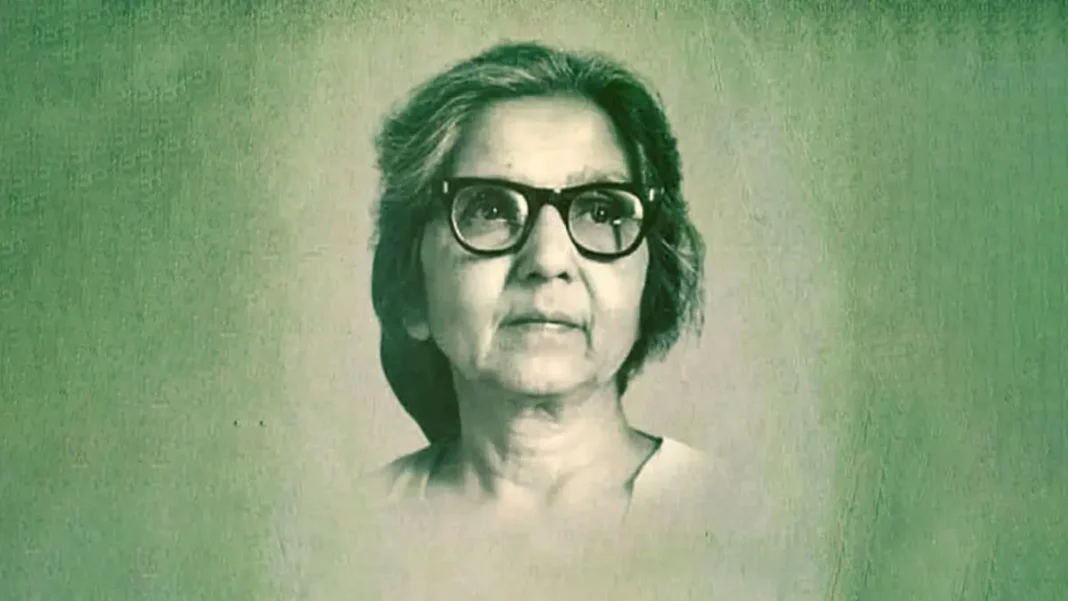
Aruna Asaf Ali, born on July 16, 1909, in Kalka, Punjab (now Haryana), was one of the most courageous women freedom fighters in India’s struggle for independence. She earned the title “Grand Old Lady of the Independence Movement” for her fearless leadership during the Quit India Movement of 1942, when she defied British colonial authority in one of the most iconic moments of India’s freedom struggle. Her life was marked by extraordinary bravery, ideological conviction, and an unwavering commitment to India’s liberation.
Early Life and Education
Aruna was born into a Bengali Brahmin family that followed the Brahmo Samaj, a progressive Hindu reform movement. Her father, Upendranath Ganguly, originally from Barisal District in Eastern Bengal (now Bangladesh), was a restaurateur, while her mother, Ambalika Devi, was the daughter of Trailokyanath Sanyal, a prominent Brahmo Samaj leader and composer of Brahmo hymns. This liberal and religiously progressive upbringing profoundly influenced Aruna’s worldview and her later commitment to social justice.
She received her education at Sacred Heart Convent School in Lahore and later at All Saints’ College in Nainital. After completing her education, she worked as a teacher at the Gokhale Memorial School in Calcutta, where her life would take a transformative turn.
Marriage and Entry into Politics
While working in Calcutta, Aruna met Asaf Ali, a prominent lawyer and Congress leader, in Allahabad. Despite strong opposition from her family on grounds of both religion—he was Muslim while she was a Brahmo—and a significant age difference of more than twenty years, they married in 1928. This marriage was itself an act of defiance against communal prejudices and social conventions.
Her uncle was so opposed to the marriage that he declared her dead to the family and performed her shraddh, a Hindu funeral rite. However, this marriage became the gateway to Aruna’s political awakening. Through her husband, who was deeply involved in the freedom struggle and defended revolutionaries including Bhagat Singh, Aruna was introduced to the Congress Party and became involved in the Indian Independence Movement.
The Salt Satyagraha and Early Activism (1930-1932)
Aruna’s first major political action came in 1930 when she participated in the Salt March, also known as Salt Satyagraha, launched by Mahatma Gandhi. She joined campaigns and processions and was arrested, along with thousands of others, for her political activism during this nonviolent movement against the British salt tax. She was charged with being a vagrant and sentenced to one year’s imprisonment.
When the Gandhi-Irwin Pact was signed in 1931, promising the release of all those arrested during the Salt Satyagraha, Aruna was not initially released. Only after strong protests by Mahatma Gandhi and other women freedom fighters was her release secured. Her fellow women prisoners refused to leave until she too was freed, demonstrating the solidarity and respect she had already earned among fellow activists.
In 1932, she was arrested again and held in Tihar Jail, where she launched a hunger strike to protest the treatment of other political prisoners. Her protest succeeded in improving conditions for inmates, but she was subsequently moved to solitary confinement in Ambala. After her release, she withdrew from active politics for nearly a decade, a period of relative quietude before her most dramatic contribution to the freedom struggle.
The Quit India Movement: A Defining Moment (1942)
The year 1942 marked the turning point in Aruna Asaf Ali’s life and her place in Indian history. On August 8, 1942, the All India Congress Committee passed the historic Quit India resolution at its Bombay session. In response, the British government immediately arrested major leaders including Mahatma Gandhi, Jawaharlal Nehru, and all members of the Congress Working Committee, attempting to preemptively crush the movement.
With the entire leadership imprisoned, the movement faced a critical moment. On August 9, 1942, young Aruna Asaf Ali, then just 33 years old, presided over the remainder of the session and boldly hoisted the Indian National Congress flag at the Gowalia Tank Maidan (now August Kranti Maidan) in Bombay. The police fired upon the assembly, but this act marked the official commencement of the Quit India Movement. This single act of defiance transformed her into a national icon.
Aruna was dubbed the “Queen of the 1942 movement” for her bravery in the face of danger. Her courage in that moment, standing before thousands of Indians and hoisting the flag despite the threat of violence, galvanized the youth of India and became one of the most enduring images of the independence struggle.
Underground Resistance (1942-1946)
An arrest warrant was issued in Aruna’s name, but she went underground to evade arrest and began coordinating an underground movement. Her property was seized and sold by the British authorities. The government announced a reward of 5,000 rupees for her capture.
During her time underground, Aruna played a crucial organizational role. She edited Inquilab, a monthly magazine of the Congress Party, along with Ram Manohar Lohia. In a 1944 issue, she exhorted the youth to action by asking them to forget futile discussions about violence and non-violence and join the revolution. Leaders such as Jayaprakash Narayan and Aruna Asaf Ali were described as “the political children of Gandhi but recent students of Karl Marx”, reflecting her socialist leanings and revolutionary approach.
She coordinated an underground network aligned with the Indian National Congress and socialist factions, facilitating the distribution of prohibited literature, secret communications among regional activists, and logistical support for sustained resistance against colonial suppression. This network collaborated with figures such as Ram Manohar Lohia, Jayaprakash Narayan, and Achyut Patwardhan, enabling parallel governance structures in parts of Bihar and Uttar Pradesh where local sabotage and non-cooperation disrupted British administration.
She fell ill and was for a period hiding in Dr. Joshi’s Hospital in Karol Bagh in Delhi. Mahatma Gandhi sent her a handwritten note asking her to come out of hiding and surrender herself, stating that her mission was accomplished and suggesting she could utilize the reward amount for the Harijan cause. However, she came out of hiding only after the warrant against her was withdrawn in 1946. Her defiance of even Gandhi’s advice demonstrated her independent spirit and strong convictions.
Support for the Royal Indian Navy Mutiny (1946)
In February 1946, Aruna took a controversial but principled stand that further highlighted her independent thinking. When the Royal Indian Navy ratings launched a mutiny against British rule, protesting racial discrimination and poor working conditions, most major political leaders, including the Congress leadership and the Muslim League, condemned the mutiny and urged the sailors to surrender. However, Aruna Asaf Ali was one of the few prominent political leaders to offer support for the mutineers.
She saw the Royal Indian Navy mutiny as the single greatest unifying factor of Hindus and Muslims at a time that was the peak of the movement for Pakistan. However, she also faced criticism from Gandhi for her support of this movement. When advised that the ratings should resign, Aruna responded: “If they did that they will have to give up their only means of livelihood. Moreover, they were fighting for principles”. Her support for the mutineers reflected her belief in militant resistance and her concern for the working-class sailors’ rights, even when it meant standing apart from the mainstream nationalist leadership.
Political Ideology and Affiliations
Aruna Asaf Ali’s political journey reflected a consistent commitment to socialist principles and working-class movements. She was a member of the Congress Socialist Party, a faction within the Congress for activists with socialist leanings. After independence, she left the Congress Socialist Party to join the Communist Party of India (CPI). She played a crucial role in the formation of the National Federation of Indian Women in 1954, which was the women’s wing of the CPI.
However, her political affiliations remained fluid based on her principles. She left the CPI following Nikita Khrushchev’s rise upon the death of Joseph Stalin in 1956, demonstrating her willingness to break with organizations when they no longer aligned with her values. She later rejoined the Congress Party in 1964, though she stepped back from active politics.
Post-Independence Contributions
After India achieved independence in 1947, Aruna Asaf Ali remained committed to public service and social reform. In 1958, she became the first elected Mayor of Delhi and was responsible for major civic reforms. This position allowed her to continue serving the nation, now focusing on urban governance and social welfare.
She was dedicated to mobilizing support for Dalits and opposed “needless industrialization” as she believed it would lead to environmental degradation and social alienation. Her concerns about sustainable development and social justice were remarkably prescient.
While she worked towards the upliftment of women, she faced criticism from feminist groups for resisting affirmative action for women. She believed that education and better healthcare would do more for women than reservation. This position reflected her belief in structural reforms over identity-based quotas.
She ran the Left-leaning Patriot newspaper and the weekly magazine Link in New Delhi, continuing her role in shaping public discourse and disseminating progressive ideas through journalism.
Personal life brought tragedy when Asaf Ali died in 1953, ending a partnership that had been both personally supportive and politically significant. She remained close to Indira Gandhi despite being a critic of the Emergency, showing her ability to maintain personal relationships while holding firm to her political principles.
Personal Character and Legacy
Aruna Asaf Ali was well known for her Spartan lifestyle—she used public transport even in her eighties. This simple living reflected her deep commitment to the common people and rejection of elite privileges.
Her independent streak was legendary. Known for her independent streak, she even disobeyed Gandhi’s request to surrender herself in 1946, prioritizing her own judgment and the needs of the underground movement over deference to established leadership.
Recognition and Awards
India acknowledged Aruna Asaf Ali’s immense contributions through numerous honors:
- International Lenin Peace Prize in 1964
- Jawaharlal Nehru Award for International Understanding in 1991
- Padma Vibhushan, India’s second-highest civilian honor, in 1992
- Bharat Ratna, India’s highest civilian award, posthumously in 1997
- A commemorative stamp issued in 1998
Aruna Asaf Ali Marg in New Delhi was named in her honor. The All India Minorities Front distributes the Dr. Aruna Asaf Ali Sadbhawana Award annually. There is also a government hospital in New Delhi named in her honor, the Aruna Asaf Ali Government Hospital.
Death and Enduring Significance
Aruna Asaf Ali passed away in New Delhi on July 29, 1996, at the age of 87. Her death marked the end of an era, but her legacy continues to inspire generations of Indians.
Aruna Asaf Ali’s life embodied the spirit of resistance, courage, and principled action. She was not merely a participant in India’s freedom struggle; she was a leader who stepped forward at critical moments when leadership was most needed. Her willingness to defy both colonial authority and established nationalist leadership when her conscience demanded it set her apart as a truly independent and fearless voice.
Her story is particularly significant for women’s history in India. At a time when women’s participation in politics was limited, Aruna not only participated but led, inspired, and organized. She proved that women could be at the forefront of revolutionary movements, making decisions that shaped the course of history.
The image of young Aruna Asaf Ali hoisting the tricolor at Gowalia Tank Maidan remains one of the most powerful symbols of India’s freedom struggle—a moment when courage, conviction, and patriotism combined to challenge an empire. Her life reminds us that freedom is won not just through institutional politics but through the bravery of individuals willing to risk everything for their beliefs.
As India continues its journey as an independent nation, Aruna Asaf Ali’s legacy serves as a reminder of the sacrifices made by countless freedom fighters, and particularly of the crucial role played by women in securing India’s independence. Her life stands as testament to the power of individual courage, the importance of principled action, and the enduring spirit of resistance against injustice.