
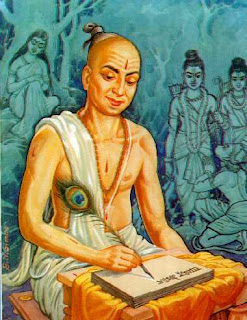
In the thirteenth century, when religious rivalries threatened to tear apart Telugu society, a poet-minister wielded his pen like a sword to unite a divided land. Born in 1205 into a Telugu-speaking Niyogi Brahmin family, Tikkana Somayaji emerged as the second poet of the legendary “Trinity of Poets” who translated the Mahabharata into Telugu. His life was a remarkable tapestry woven with threads of diplomacy, philosophy, literature, and statecraft a story of how one man’s vision transformed not just Telugu literature, but the very soul of a civilisation torn by sectarian hatred.
The Golden Age and the Growing Darkness
An Empire United, A Society Divided
The thirteenth century marked the Golden Age of the Kakatiya Empire under Emperor Ganapatideva, who brought all Telugu kingdoms under unified rule for the first time, creating conditions for prosperity and the flourishing of art and literature. Yet paradoxically, whilst political unity strengthened, religious divisions deepened. Shaivites and Vaishnavites, once philosophical rivals, now became bitter enemies. Buddhists and Jains, ancient pillars of Indian spirituality, found themselves targets of persecution. The poison of extremism seeped into every aspect of life social gathering, marriages, temple worship, even matters of state.
Religious symbols became weapons. Followers of each faith displayed their allegiance openly, denouncing and even harming those who worshipped differently. The plural wisdom of Vedic thought, built upon six philosophical schools, collapsed under the weight of narrow sectarianism. What had begun as theological debate escalated into social rivalry, and threatened to destroy the very fabric of Telugu civilisation.
Into this fractured world stepped Tikkana Somayaji, carrying both the weight of tradition and the burden of hope.
The Poet-Minister: A Life of Many Battles
Born to Serve Kings and Gods
Tikkana was born in 1205 in Patur village, Kovur, Nellore district, during the reign of the Nellore Chodas. His name itself tells a story he was called Tikkana Somayaji because he completed the sacred Somayaga ritual, earning both spiritual merit and the title of Somayaji. His family tradition was one of learning and Shaivite devotion, but Tikkana would transcend these boundaries to embrace a larger vision.
He rose to become the Prime Minister of Manumasiddhi, the King of Nellore, a tributary state under the mighty Kakatiya Empire. As Tikkanamatya minister Tikkana, he would navigate the treacherous waters of court politics, international diplomacy, and military strategy, experiences that would profoundly shape his literary masterwork.
The Crisis of the Throne: Diplomacy in Action
When Manumasiddhi was overthrown by his cousins Akkanna and Bayyanna in a palace coup, forcing the rightful king to flee Vikramasimhapuri in secrecy, Tikkana journeyed to Warangal, the Kakatiya capital, to seek help from Emperor Ganapatideva.
What followed was a meeting of two giants the poet-minister and the philosopher-emperor. The Siddheshwara Charitamu records that Ganapatideva received Tikkana with full state honours, recognising in him not just a diplomat but a fellow scholar and intellectual. Here was statecraft at its finest: Tikkana’s eloquence and poetic brilliance impressed the emperor, who saw beyond mere politics to a larger vision of cultural unity.
Ganapatideva’s army marched on Vikramasimhapuri, dethroned the usurpers, and reinstated Manumasiddhi to his rightful throne. According to historical records, Ganapatideva rewarded Tikkana with treasures worth nine lakh and granted him villages sixty eight according to one source, twenty-five thousand according to another. But the real reward was yet to come: the emperor’s patronage would give Tikkana the stability and resources to embark on his greatest work.
Tikkana also took part in strategising the war, helping Ganapatideva prevent the usurper Katamaraja from receiving military aid from allies, ultimately leading to victory for Manumasiddhi. In these experiences exile, diplomatic missions, war preparations, the restoration of dharma Tikkana found the living embodiment of the Mahabharata itself. His translation would be enriched by these real-world parallels.
The Intellectual Warrior: Debates at the Royal Court
During Ganapatideva’s reign, as Shaivites, Vaishnavites, Jains, and Buddhists fought amongst themselves, the emperor arranged religious meetings to control this intolerance, and Tikkana participated in these debates. To impress Ganapatideva, Tikkana engaged in philosophical debates with Buddhist and Jain scholars, defeating them and establishing Brahminical philosophy.
But victory in debate was not his ultimate goal. What Tikkana sought was something far more profound.
The Divine Vision: When Harihara Appeared
A Question That Changed Everything
In his moment of deepest anguish, witnessing society torn asunder by religious hatred, Tikkana composed verses that would echo through centuries. In the introductory portion of the Virata Parvan, he questions the deity: “Garland of skulls or the lustrous kaustubha gem which do you prefer as an ornament? Tell me, O god, which do you like better? Kalakuta poison, or the sweet breast-milk of Yashoda?”
This was no mere poetic flourish. Tikkana invoked the symbols of both Shiva (the skull garland and poison) and Krishna-Vishnu (the Kaustubha gem and Yashoda’s milk), demanding an answer that could shatter the false divisions consuming his society.
According to tradition preserved in the Virata Parvan, Tikkana had a dream in which his father and the deity Harihara appeared, asking him to translate the Mahabharata to establish harmony in society. The vision was clear: the god was one, bearing attributes of both Shiva and Vishnu. To fight sectarian hatred, Tikkana would dedicate his translation to Hariharanatha the unified form of Hari (Vishnu) and Hara (Shiva).
The Philosophy of Harihara-Advaita
Tikkana preached that Lord Shiva and Lord Vishnu were one, and that the apparent differences in names were made up and untrue, a philosophy known as Harihara Advaita or Harihara-Abheda the Unity of Hari and Hara. Though the concept of the oneness of Shiva and Vishnu had ancient roots, never before had circumstances demanded it become a social movement.
Scholars note that the religious extremism had broken beyond philosophical rivalry into social rivalry, with followers displaying symbols, discouraging Vedic plurality, and even denouncing or harming followers of other religions. This poisonous atmosphere demanded not just philosophical argument but transformative action through art and literature.
To firmly establish this principle of unity, Tikkana would undertake the monumental task of translating the Mahabharata into Telugu a work that would be at once literary masterpiece, philosophical treatise, and social manifesto.
The Great Translation: Completing the Sacred Task
The Unfinished Legacy of Nannaya
The Sanskrit Mahabharata’s translation into Telugu began with Nannaya Bhattaraka, the first poet who translated two and a half chapters Aadi Parvam, Sabha Parvam, and half of Aranya Parvam between 1054 and 1061 CE, before his death left the work incomplete. For nearly two centuries, Telugu people waited for someone to continue this sacred labour.
In the thirteenth century, Tikkana translated fifteen parvams from Virata Parvam to Swargarohana Parvam, but deliberately left the remainder of Aranya Parvam untouched, as it was considered inauspicious to complete what Nannaya had left half-finished. That portion would wait another century for Errana to bridge the gap in the fourteenth century.
A Style Rooted in the Soil
What distinguished Tikkana’s work was not merely its scope but its revolutionary approach to language. His writing style was mostly Telugu, unlike Nannaya whose work was heavily Sanskritised. Tikkana used Telugu words even to express very difficult ideas, extensively employing Telugu words and parables.
The flavour of Telugu national similes spiced up his poetry: “as if pure white cheera is touched by soot,” “like the lizard in the milk,” “like the fire in which ghee was poured,” “fate of locusts that flew into the fire,” “like the eyelid for the eye,” “like a frog in the well.” These were not just literary devices but the very heartbeat of Telugu culture, making the epic accessible to common people whilst maintaining its philosophical depth.
He Telugised Sanskrit sayings and used them in his work, extensively employing Telugu proverbs and parables, even modifying and using informal and slang Telugu. This was a democratic vision of literature the greatest epic not as property of Sanskrit scholars alone, but as inheritance of every Telugu speaker.
Poetry Born of Experience
Tikkana’s section of the Mahabharata, including the incognito exile of the Pandavas, diplomatic missions, war preparations, the war itself, and the re-establishment of dharma, was enriched by his own real-life experiences. When he wrote of exile, he remembered Manumasiddhi’s flight. When he described diplomatic missions, he recalled his own journey to Warangal. When he depicted the strategies of war, he drew upon battles he had helped plan.
In a permitted level of exaggeration, Tikkana was to Manumasiddhi what Krishna was to the Pandavas and what Chanakya was to the Mauryas. His poetry carried the weight of lived wisdom, not mere scholarly invention.
Beyond the Mahabharata: A Literary Legacy
Other Jewels in the Crown
Tikkana’s first literary work was Nirvachanottara Ramayanamu, dedicated to Emperor Ganapatideva, narrating the later part of the Ramayana—Sita’s banishment to forests and the birth of Lava and Kusa. This work displayed a highly Sanskritised style, showcasing his mastery of classical forms even as he would later champion the vernacular.
His other literary contributions included Vijayasenamu, Kavivaagbandhamu, and Krishnasatakamu. Each work demonstrated different facets of his genius philosophical depth, technical mastery, devotional fervour.
The Poet Who Bridged Worlds
In the colophons of his work, Tikkana called himself “a friend to both kinds of poets” Ubhaya-kavi-mitra. Scholars have debated the meaning: did he mean Sanskrit and Telugu poets? Shaivite and non-Shaivite poets? Brahmin and non-Brahmin poets? Folk poets and scholarly poets? Perhaps he meant all of these, for Tikkana’s genius lay precisely in his ability to bridge seemingly unbridgeable divides.
The Lasting Impact: A Society Transformed
When Telugu Found Its Voice
Tikkana is regarded as the greatest Telugu poet and a pivotal figure in the language’s literary history, earning the title Kavi Sarvabhauma Emperor of Poets. He led the second epoch in Telugu literature, transforming it from a language trying to prove itself against Sanskrit into a mature literary medium confident in its own genius.
His Mahabharata became the template for all future Telugu literature. Telugu people were fortunate to read the Andhra Mahabharatam, written by three poets over two and a half centuries, as a single book, as if a single great poet had written it at one time. This seamless unity Nannaya’s Sanskritised beginning, Tikkana’s Telugu heart, Errana’s connecting bridge created something greater than the sum of its parts.
Religious Harmony: The Gift That Keeps Giving
Tikkana’s translation was a great contribution to the peace and unity of Telugus, who were fighting bloody religious wars amongst themselves. His Harihara-Advaita philosophy helped synthesise Indian religions into the complex tradition we call Hinduism today, where respect for each distinct and diverse component Vaishnavism, Shaivism, Buddhism, Jainism, Shaktism, and even external religions became the norm.
Today, Telugus visit both Shivaite and Vaishnavite temples without conflict. In North America, Indians have built modern temple complexes where they pray to Shiva, Vishnu, and many more gods together, representing the indigenous religions of the vast Indian subcontinent. This religious pluralism, taken for granted now, owes much to pioneers like Tikkana who fought for unity when division seemed inevitable.
Political and Cultural Influence
After Manumasiddhi’s death, Vikramasimhapuri became part of the Kakatiya Empire under Pratapa Rudra II, and Tikkana’s direct disciple Marana became a court pundit of that emperor. The literary lineage continued, with Marana’s Markandeya Purana becoming so influential that even a century later, the great poet Allasani Peddana under Sri Krishnadeva Raya would draw upon it.
The fifteenth or sixteenth century poet Nutana-kavi Suranna claimed descent from Tikkana. The master’s influence rippled through generations, shaping not just literature but the very way Telugus understood their identity, their gods, and their place in the cosmos.
Remembering the Master
Monuments to a Legacy
There is a library named after Tikkana in Guntur, maintained by a committee, which celebrated one hundred years of functioning in 2013. A television series was made on the life of Tikkana. In Nellore, where he served as minister and translated the Mahabharata, his memory is preserved as part of the city’s proud heritage.
But the true monument to Tikkana lies not in stone or ceremony. It lies in every Telugu home where the Mahabharata is read, in every temple where Shiva and Vishnu are worshipped without enmity, in every literary work that follows his example of making high philosophy accessible in the people’s language.
The Eternal Relevance
Though he was second to Nannayya in attempting to translate the Mahabharatamu and second poet amongst the Trinity, he was second to none in his political, religious, and literary accomplishments. In truth, categories like “first” and “second” fail to capture Tikkana’s unique genius. He was not merely a translator but a transformer taking Sanskrit verses and reimagining them in Telugu soul, taking religious hatred and transmuting it into philosophical unity, taking courtly experience and weaving it into epic poetry.
The Telugu mythological film Nartanasala captured many poems from Tikkana’s Virata Parvamu, depicting Draupadi’s warning to Keechaka, Arjuna’s challenge to Duryodhana, and the description of Kaurava warriors by their flags testaments to how his work continues to inspire modern artists.
The Timeless Message
In an age when religious extremism threatens societies across the globe, when sectarian violence erupts in the name of gods who preach love, when linguistic and cultural chauvinism divides communities, Tikkana’s life and work offer a timeless lesson.
He showed that the highest form of devotion is not narrow sectarianism but inclusive spirituality. He demonstrated that great literature serves society not by retreating into ivory towers but by engaging with its deepest conflicts. He proved that a minister could be a philosopher, a poet could be a diplomat, and a scholar could be a warrior for peace.
Tikkana Somayaji lived from 1205 to 1288 eighty-three years that changed the course of Telugu civilisation. In the colophon of one of his works, addressing his patron deity, he wrote words that could serve as his epitaph: the differences we see are illusions we create; the unity we seek already exists; we need only the eyes to see it and the courage to proclaim it.
In a world still torn by divisions Tikkana fought to heal, his words remain not relics of history but living weapons weapons of unity, wielded through the power of literature, the strength of philosophy, and the grace of poetry that speaks to the eternal in every human heart.
The pen he lifted in the thirteenth century still writes. The verses he composed still sing. The unity he envisioned still calls us, across centuries, to remember what we have forgotten: that we are one, we have always been one, and the gods who seem to divide us are waiting, with infinite patience, for us to see their single face.